
Trade
For builders and project managers
Get us in before the concrete is ordered. Aggregate, colour and flatness are decided at the pour, and none of them can be added afterwards.
Approved PeterFell C2 Applicator
Approved TextureSafe Applicator
Twenty-Five Years Combined Experience
Aggregate distribution, colour and flatness are decided when the concrete is placed. None of them can be manufactured afterwards, so the outcome of a polished floor is largely set before we arrive on site.
Get us involved at design or pricing stage and the floor is planned with the pour. Get us involved after the slab is down and we are working with whatever the pour gave us.
Three pages carry the detail a specifier needs next: the technical and specification detail page with systems, depths, grit endpoints and a clause you can lift straight into a schedule, the concrete colour and aggregate guide for decisions that have to be made before the pour, and the depth of cut and exposure ladder for setting the finish on the drawings.
Before the pour
Identify the polished areas before placement, not after. Once the concrete is down the decisions have been made for you.
- Floor plans
- Plans marked with the areas to be polished
- Exposure
- The desired depth of cut and aggregate exposure
- Colour
- Colour selection, confirmed with the plant
- Aggregate
- Any aggregate requirement for the intended appearance
- Sealer
- The proposed sealer system
- Dates
- Pour date and the anticipated grinding dates
Mix and colour
Colour is confirmed before placement. It goes into the mix, so it cannot be added or corrected once the concrete is placed.
Aggregate appearance varies by plant, by quarry and by mix. Two loads described the same way can read differently in the finished floor.
For architecturally significant floors a sample or reference slab is recommended, poured from the same mix and finished the same way.
Colour goes in at the pour. It cannot be added afterwards.
Placement
Place as flat and consistent as practical. Flatness decides how evenly the aggregate is exposed, because high areas cut sooner than low areas.
Hold consistent depth and a consistent mix, and avoid changes between loads.
Keep ferrous materials off damp concrete. Keep oil, diesel, hydraulic fluid and paint off the slab.
Protecting the slab
Most of the defects we are asked to remove are contamination, not wear. They are put into the slab by other trades in the weeks after the pour.
Do
- Cover the slab with a breathable protective layer once it is placed
- Keep the floor clear of stacked materials and off cuts
- Sweep and remove debris before it is walked into the surface
- Contain plaster, paint, adhesive and grout with drop sheets
- Report any spill or contamination to us as soon as it happens
- Keep the slab dry once the building is closed in
Do not
- Do not leave ferrous materials, offcuts or fixings on damp concrete
- Do not allow oil, diesel, hydraulic fluid or paint onto the slab
- Do not use acids, solvents or aggressive cleaners on the surface
- Do not park plant or vehicles on a slab that is to be polished
- Do not let standing water sit on the floor
- Do not fix, glue or tape anything directly to the finished surface
Timing
A minimum concrete age of 28 days from the date of pour is required before polishing commences. This is a curing requirement.
Provide the confirmed pour date when programming the works, so the grinding dates can be set against it rather than guessed.
Minimum 28 days from the date of pour.
Colour, aggregate and flatness are decided at the pour, not on the day we arrive.
06 Best stage of construction
When to bring us in
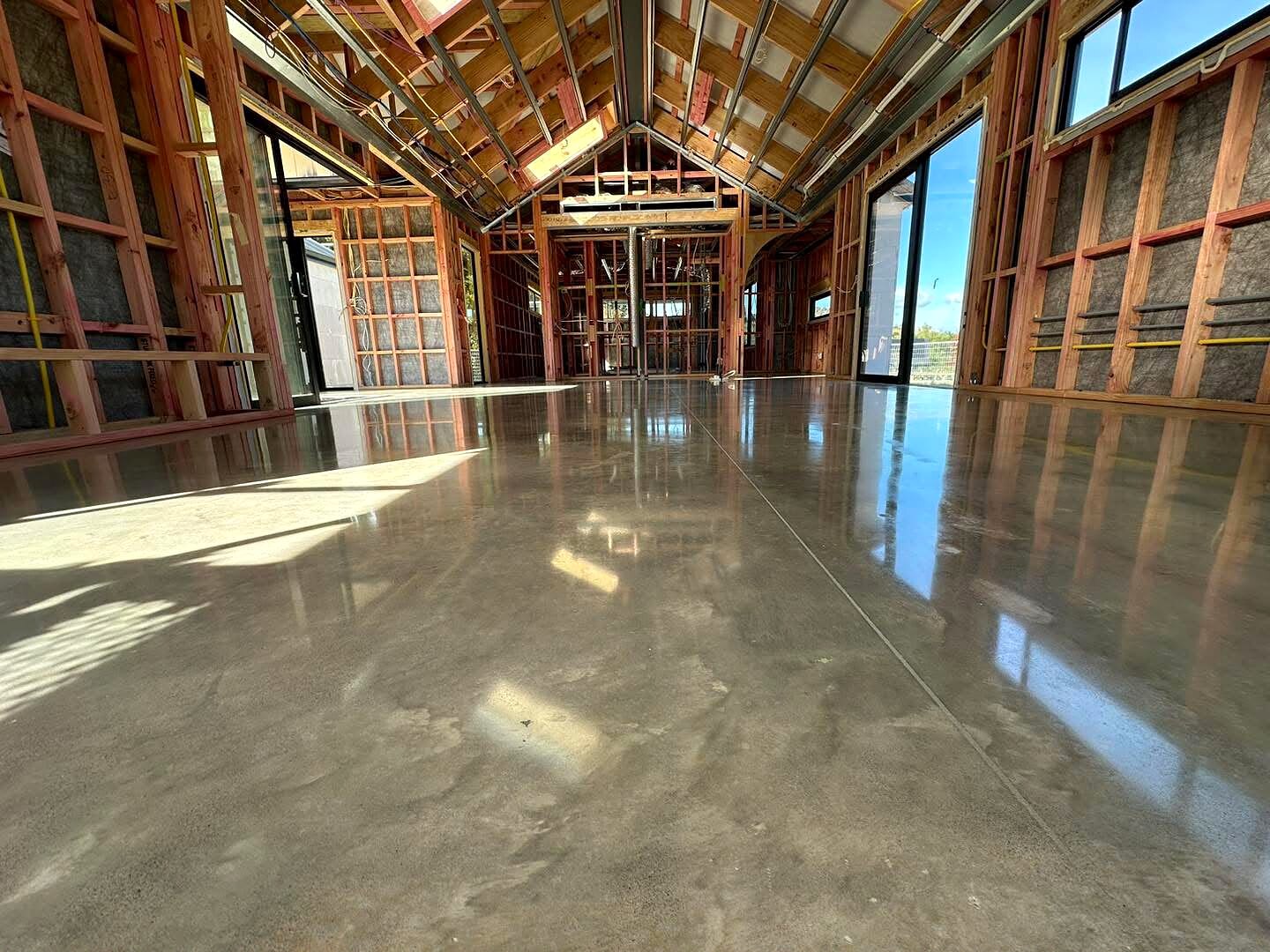
The ideal window is once the building is watertight and the exterior joinery is installed, and before skirtings, kitchens and painting. Grinding at that point keeps dust out of finished work and keeps the floor out of the way of the trades that follow.
07 Site requirements
What we need before we arrive
- Building
- Watertight and closed in
- Floor
- Clear of trades, materials and stacked product
- Services
- Single phase power and water available on site
- Access
- Vehicle and equipment access to the work area
- Water
- No standing water on the slab
- Dry
- Saw cuts and framing dry
- Programme
- Uninterrupted access for the duration of the works
- Fit out
- Cabinetry and skirtings ideally not yet installed
A minimum concrete age of 28 days from the date of pour applies to every new slab. It is a curing requirement.
08 Expectations
What polished concrete is
Polished concrete is not a manufactured tile or sheet product. It is a structural slab cut back and closed, and it carries the record of how it was placed.
- Aggregate concentration, orientation and colour vary naturally across a floor
- Colour varies between loads, between batches and between plants
- Edges, doorways and penetrations can read differently from the main floor
- Hand trowelled areas can polish differently from power trowelled areas
- Control joints, saw cuts and construction joints remain visible
- Trowel marks, placement lines and minor surface variation are part of the material
- Existing cracks can be filled but remain visible, and new shrinkage cracking can occur
- Repairs and patches will not match the surrounding floor exactly
Common questions
When should you be involved in the project?
At design or pricing stage, before the concrete is ordered. Colour, aggregate and the flatness required for the intended finish are all decided before placement.
How long after the pour can the floor be ground?
A minimum concrete age of 28 days from the date of pour is required before polishing commences. This is a curing requirement. Provide the confirmed pour date when programming the works.
What stage of construction suits grinding?
Once the building is watertight and the exterior joinery is installed, and before skirtings, kitchens and painting. The floor is then protected through the remaining fit out and buffed at the end.
What do you need on site?
A watertight building, a floor clear of trades and materials, single phase power and water, vehicle and equipment access, no standing water, dry saw cuts and framing, and uninterrupted access for the duration of the works.
Can contamination be fixed?
Some of it. Surface debris and light staining usually grind out. Oil, diesel, hydraulic fluid and rust from ferrous materials carry into the concrete and can remain visible after grinding, so keeping them off the slab is the only reliable answer.
Do we need to specify the aggregate?
For a natural or salt and pepper finish, usually not. For medium and full exposure the aggregate is the floor, so plant, stone size and colour are specified before the concrete is ordered.
Grinding Dynamics is an approved applicator of the PeterFell C2 Polished Concrete System and the PeterFell TextureSafe System. System data and specifications are published by PeterFell.
Verify the systems at peterfell.co.nz
Send us the plans and the pour date and we will tell you what the floor needs.
Site assessment and written quote, no obligation.