Renovation

Deciding
Approved PeterFell C2 Applicator
Approved TextureSafe Applicator
Twenty-Five Years Combined Experience
Grinding Dynamics
Published 17 August 2026 · 10 minute read
Everybody wants a rate per square metre, and on its own it is close to meaningless. The same machine, the same crew and the same sealer can produce two jobs on the same street where one costs half of what the other does, because the slabs were not the same slab. Area is a multiplier. What is being multiplied is decided by the concrete.
So rather than a number you cannot use, here is what a polished concrete quote is actually built from, in the order it gets priced. Read it and you will be able to tell the difference between a quote that has been thought about and a quote that has left something out.
A price per square metre means nothing until someone has seen the slab.
Every job carries a fixed setup: getting plant to site, unloading it, running power and water, masking, dust containment, and packing down at the end. On a small room that setup is spread across a handful of square metres. On a large open warehouse floor it is spread across hundreds.
Machine efficiency compounds it. In a big open area the grinder runs continuously in long passes, which is the fastest way to remove material. In a small or broken up space the operator spends more time turning, lifting and repositioning than cutting. That is why a large open floor is meaningfully cheaper per square metre than a set of small rooms totalling the same area.
This is the single largest unknown in any quote on an existing floor, and the honest answer is that nobody can price it accurately from a photograph.
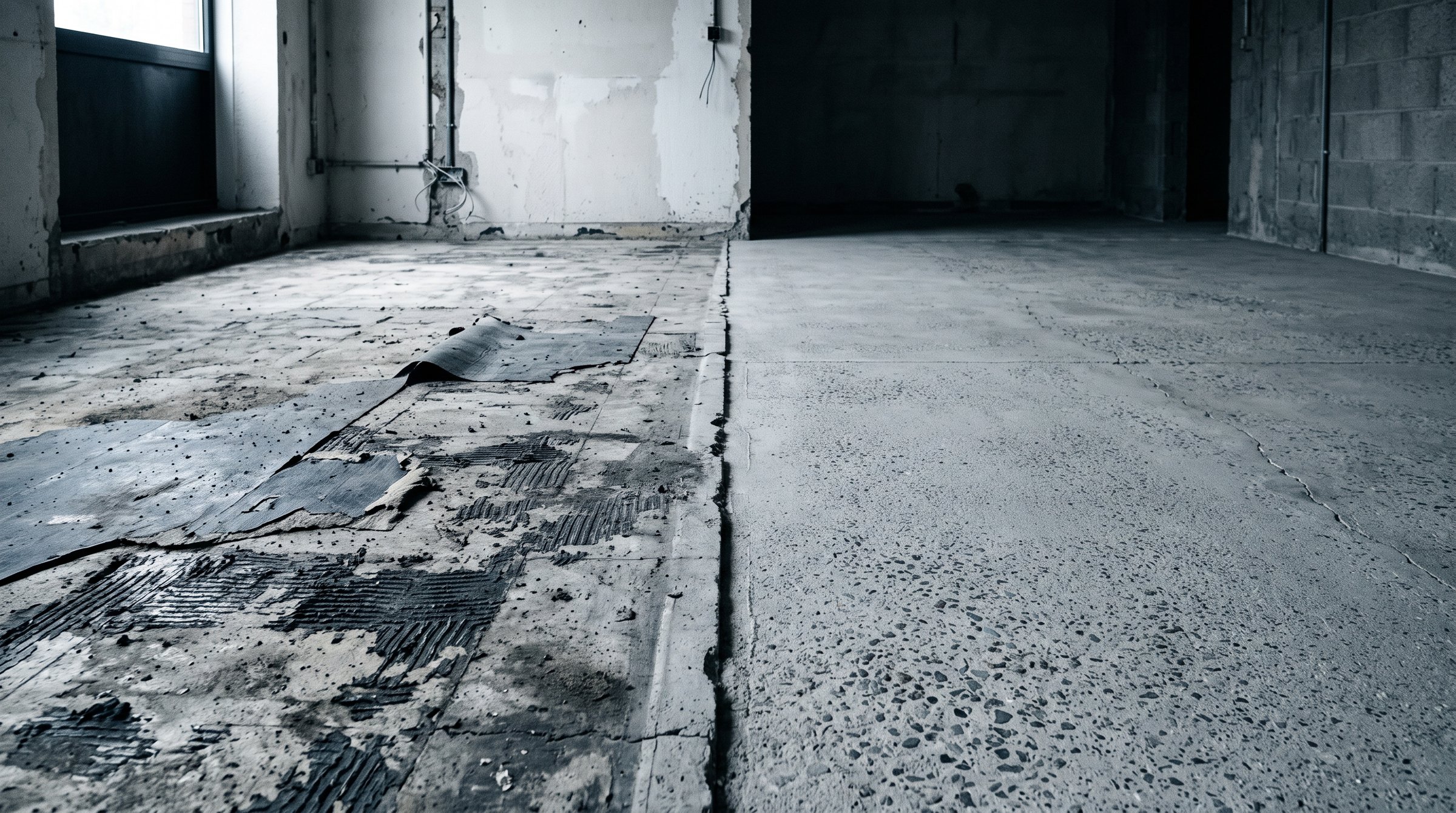
Adhesive removal is the most common surprise. Old vinyl glue, carpet tack strip residue, tile mortar beds and levelling compound all have to come off before polishing begins, and they behave differently. Some glue comes away in a pass. Bitumen based adhesive smears, loads the diamonds and slows everything down. A thick mortar bed under a tiled floor can take more grinding to remove than the polishing itself.
Coatings are the same story. A thin sealer lifts easily. A two pack epoxy in good condition is hard work. Multiple layers applied over years, each bonded differently, is the worst case. That is why a test area matters so much on any existing slab, and why a quote given without one carries either a large contingency or a variation waiting to happen.
The strip on the right is what a test area is for. What is bonded to the slab decides more of the price than the polishing does.
A polished floor is built through a sequence of passes with progressively finer diamonds. A cream or light exposure removes very little material and needs fewer coarse passes. A full stone exposure means cutting several millimetres off the whole floor, which is more time, more diamond wear and more slurry to manage.
Concrete hardness compounds it. A hard, well cured, densely trowelled slab resists cutting and takes longer per pass than a soft one. Two identical looking floors can differ substantially in grinding hours purely on how hard the concrete is, which is another thing only a test grind reveals.
A large planetary grinder cannot get within a hundred millimetres of a wall, a column, a cabinet kick or a threshold. Those areas are cut with a hand held edge grinder, and hand work is many times slower per square metre than machine work.
This is why an open shell and a fitted out room of the same area are not the same price. A kitchen with an island, a laundry with cabinetry, a room with three doorways and two columns has a long perimeter relative to its floor area. When you compare quotes, check that the edge work is actually in there, because leaving it out is one of the easiest ways to make a number look competitive.
Most slabs need something. Shrinkage cracks are filled with a flexible or rigid repair depending on whether they are still moving. Saw cuts and construction joints are usually filled so they do not collect dirt and so the floor reads as a single surface. Chips, pop outs and old fixing holes are patched.
Repairs are honest work and they are visible in a good quote as their own line. Be careful of a quote that mentions no repairs at all on an existing slab, because the repairs will still be needed and they will arrive later as a variation.
Plant is heavy. Grinders, vacuums, generators and drums of sealer come off a truck and have to reach the floor. A job where the truck parks at the door is a different job from one with a long carry, a set of stairs, a lift booking or a narrow site with no parking.
Upper floors, tight urban sites, steep driveways and jobs inside occupied buildings all add crew hours before any cutting happens, and they add the same hours again at the end. It is a real cost and it should be visible in the quote rather than buried in the rate.
Sheen is a function of how far up the grit sequence the floor is taken. A matt finish stops earlier. A high gloss finish requires several more passes with finer diamonds plus burnishing, and each of those passes is machine time across the whole floor.
Sealer systems vary widely in cost and in what they do. A penetrating densifier and a topical guard behave differently, cost differently and are maintained differently. A slip resistant additive for an entry or an outdoor area is another line. None of these are upsells, they are choices, and the quote should state which system is included so you can compare like with like.
Grinding produces dust and wet polishing produces slurry. Dust extraction, containment screens, masking of joinery and glazing, and protecting adjacent finished surfaces all take time and materials. Slurry and grinding waste have to be collected and disposed of properly, which is a cost, particularly on jobs where old coatings are being removed.
On an occupied building this line grows. Working around a trading business or a lived in house means more containment, more protection and often work outside normal hours.
Work in Tauranga and the immediate Bay of Plenty carries no travel loading. Jobs further out into the Waikato, the Coromandel or Auckland carry travel time for the crew, and multi day work at distance carries accommodation. On a large floor that cost disappears into the rate. On a small job a long way out it can be a significant proportion of the total, which is why small remote jobs sometimes get grouped with other work in the area.
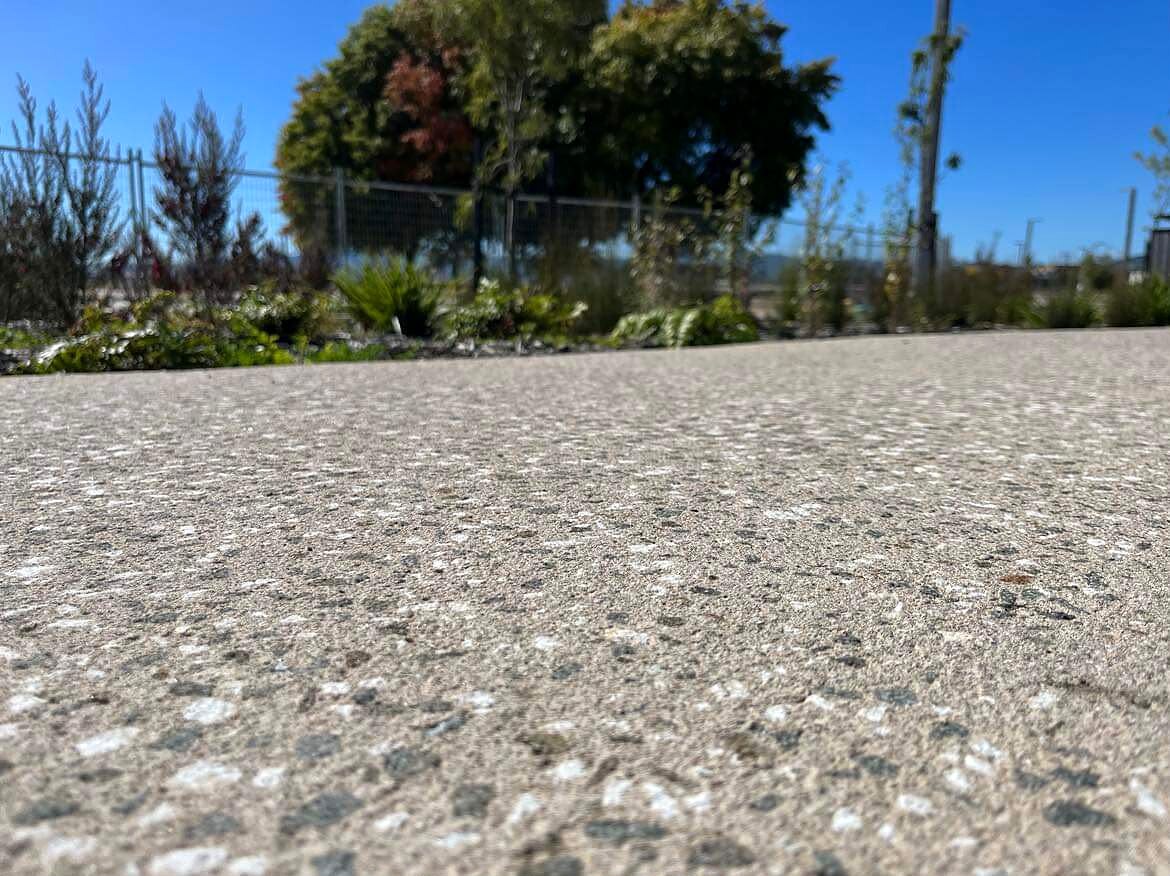
Local aggregate hardness varies by supplier, and harder stone means more grinding hours for the same finish.
| Cost driver | What increases it | What reduces it |
|---|---|---|
| Area and layout | Small rooms, broken up spaces, long perimeters | Large open areas with continuous machine runs |
| Slab condition | Old adhesive, epoxy coatings, levelling compound, heavy staining | Bare, sound, uncontaminated concrete |
| Depth of cut | Full aggregate exposure, hard densely trowelled slabs | Cream or light exposure on a softer slab |
| Edge and detail work | Cabinetry, islands, columns, thresholds, multiple doorways | An empty shell ground before fitout |
| Repairs | Wide or moving cracks, pop outs, many joints to fill | A sound slab with few joints and no movement |
| Access | Upper floors, long carries, stairs, no parking, occupied buildings | Ground floor, truck at the door, empty building |
| Sheen and sealer | High gloss, burnishing, premium or slip resistant systems | Matt or satin with a standard sealer system |
| Protection and waste | Occupied sites, adjacent finished surfaces, coating removal waste | New builds at the right stage with nothing to protect |
| Travel | Small jobs well outside the Bay of Plenty, overnight stays | Work in Tauranga and the immediate region |
Every line above is assessed on site. That is what turns a rate into a price you can rely on.
The cheapest quote is very often the one that has left something out. It is not usually dishonesty, it is scope. Two applicators looked at the same floor and assumed different things.
A quote you can rely on itemises the following.
Then look at the exclusions, because that is where the difference between two numbers usually lives. Common ones worth asking about are coating removal, unknown substrates, moisture testing, repairs beyond a stated allowance, out of hours work, and the cost of returning if the floor is not ready.
Four questions are worth asking every applicator. What is not included in this price. What would cause a variation. Have you cut a test area on my slab. And what exposure and sheen have you priced. If two quotes answer those differently, they are not quoting the same job.
Normally included: setup and containment, machine grinding to the nominated exposure, edge work, honing through the grit sequence, densifier, the sealer system nominated, basic crack and joint filling within an allowance, clean up and waste removal, and a handover with maintenance instructions.
Normally excluded: removal of existing floor coverings and coatings unless specifically priced, structural repair, levelling or topping of a badly out of level slab, moisture remediation, protection of the floor after we leave, out of hours work, and anything caused by other trades after handover.
A phone estimate is a guess with your name on it. On site we measure the actual area rather than the plan area, look at flatness, check what is bonded to the slab, cut a small test area to see the aggregate and the hardness, count the edges and the details, assess access, and identify the repairs. That takes an hour and it converts every unknown in this article into a known.
The result is a fixed price with stated exclusions rather than a rate that moves once work starts. It also gives you something to look at, because the test area shows what your floor will actually look like, which no quote can describe.
Because the two biggest variables, what is bonded to the slab and how hard the concrete is, cannot be assessed without seeing and cutting it. A phone number would be a guess wide enough to be useless, and it would either lose you money or turn into a variation later.
Mostly slab condition, depth of cut and how much hand work there is. Removing old adhesive or coatings, cutting to a full aggregate exposure, and grinding around cabinetry and columns all add hours. Two floors of identical area can differ substantially on those three alone.
Usually yes. Setup, containment and pack down are largely fixed, so they spread further across a large area, and a big open floor lets the machine run continuously in long passes. Small broken up rooms cost more per square metre than an open warehouse floor.
Typically removal of existing coverings and coatings unless priced, structural repairs, levelling of a badly out of level slab, moisture remediation, out of hours work and protection of the floor after we leave. Our quotes state the exclusions rather than leaving them implied.
Check they have priced the same exposure, the same sheen and the same sealer system, that edge work and repairs are both included, and that coating removal is either in the price or clearly excluded. Then compare the exclusions. The gap between two numbers is almost always scope rather than rate.
A standard assessment and quote within our normal service area is free. A full test grind on an existing slab, where we cut and finish a sample area so you can see the aggregate and we can price the work properly, may be charged, and that cost is credited against the job if you proceed.
What the service includes, from test grind through to sealed and handed over.
See what each depth of cut looks like before you compare a single price.
Price a floor
A few pertinent questions about your slab and space.
Step 1 of 6
Your own slab answers more than another thousand words.
Site assessment and written quote, no obligation.

Tell us about the slab and we will tell you what it can do.
Site assessment and written quote, no obligation.