Problems

Renovation
Approved PeterFell C2 Applicator
Approved TextureSafe Applicator
Twenty-Five Years Combined Experience
Grinding Dynamics
Published 16 August 2026 · 10 minute read
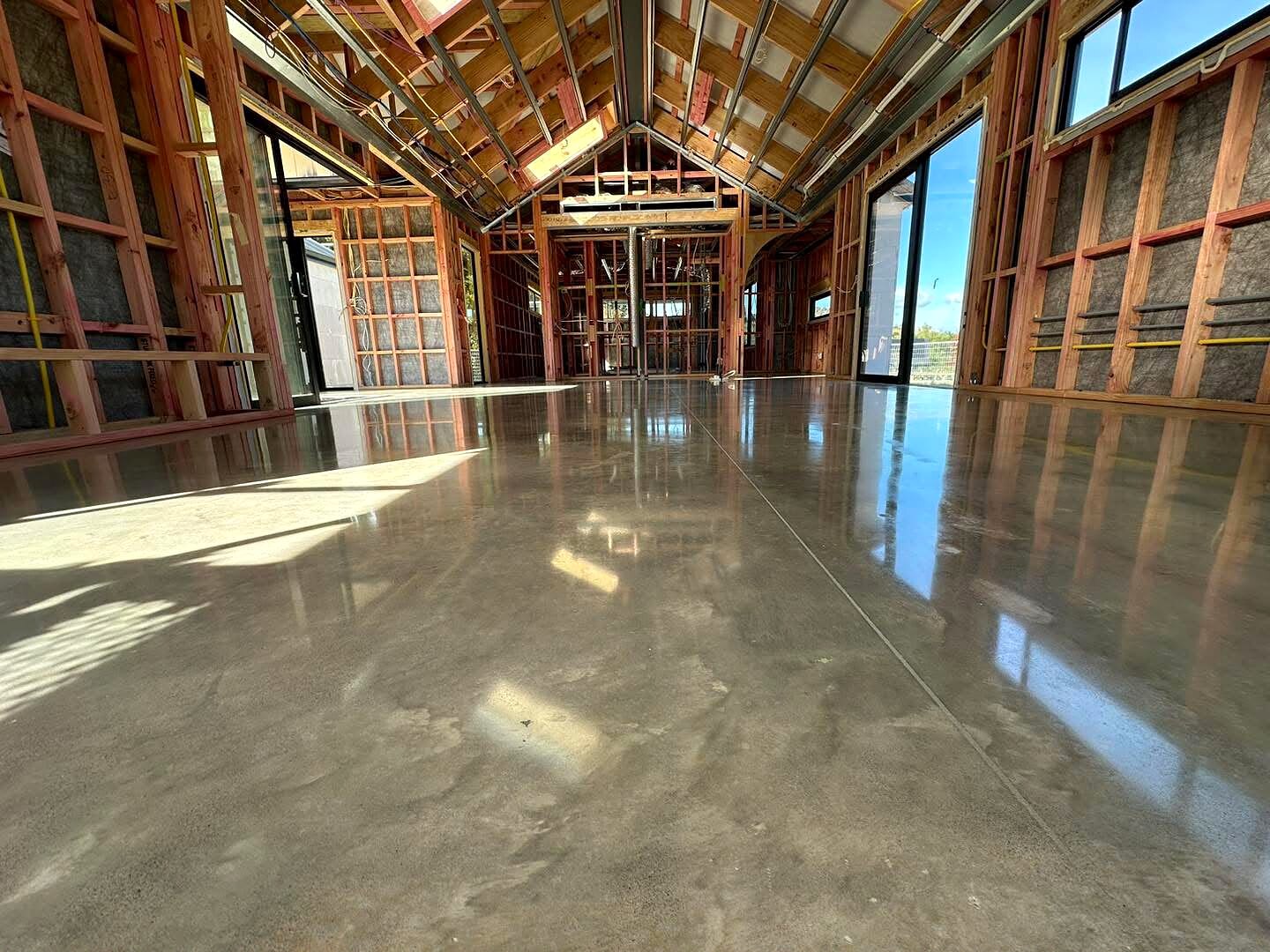
The short answer is yes, in most cases. Concrete does not expire. A slab poured in 1974 will polish, and quite often it polishes better than a new one because the concrete has reached full hardness and cuts cleanly. Age is not the question. What is on top of it, what condition it is in, and what you expect to get out of it are the questions.
This is the most common enquiry we take. Someone lifts a corner of carpet in a 1990s house or strips vinyl out of a shop and wants to know whether the floor underneath can become the finished floor. Here is how we work that out.
The slab decides more than the machine does.
This is the first question and it is the one that drives the price. Every covering behaves differently under a grinder, and the difference between the easiest and the hardest is significant.
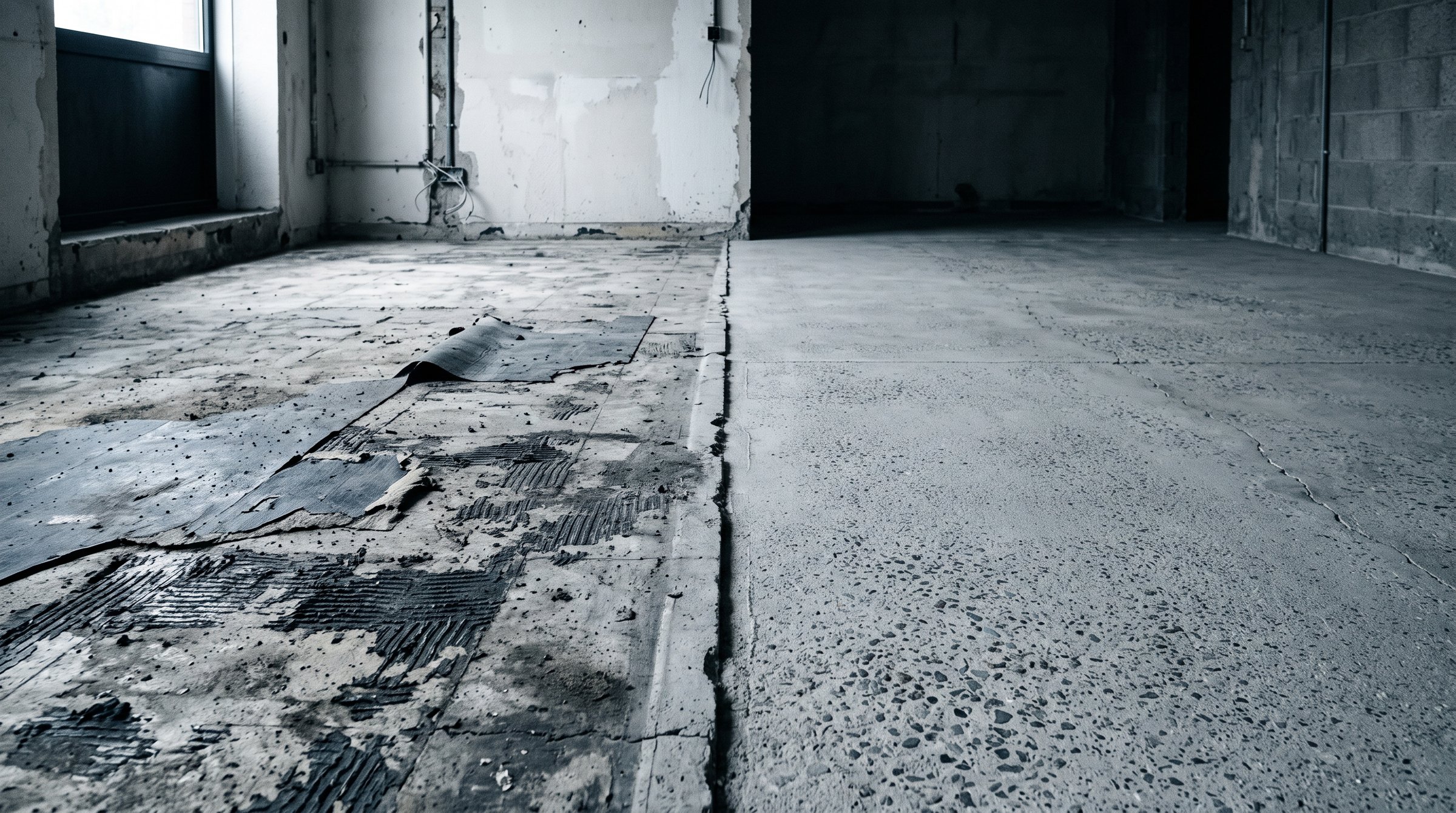
Carpet on smooth edge is the best case. Pull the carpet and the underlay, lift the tack strips, punch the nails, and you are on bare concrete. Sometimes there is a bit of nail hole filling to do and that is all.
Glued down carpet and vinyl is a different job. The adhesive has to come off mechanically, and adhesives vary enormously. Some come away in a single pass. Some are soft and heat sensitive, so they smear and load up the tooling, which means slower work and more consumables. Older black adhesives may contain asbestos and need testing before anything is touched, which is a specialist removal question rather than a grinding one.
Ceramic tiles come off with the bed under them and often take a chunk of the slab surface with them, leaving an uneven floor that needs cutting further than you would otherwise choose. Tile beds over a membrane are worse again.
Coatings such as epoxy, polyurethane and floor paint have to be removed entirely. A thin, well bonded coating grinds off predictably. A thick coating, or one that has failed and is lifting in sheets, is unpredictable and slow.
Once the covering is off we look at the concrete itself, and there are four things that decide whether the job proceeds and at what depth.
Thickness and cover. We need enough sound concrete above the reinforcement and any services in the slab to cut into. Post tensioned slabs and slabs with in floor heating need particular care, and we want the drawings before we start rather than after.
Cracks. Almost every older slab has some. Shrinkage cracking and settlement cracking are normal and are dealt with as part of the work. Structural cracking, meaning movement that is still active, differential settlement or cracking with a step in it, is an engineering question that gets answered before we quote a finish.
Delamination. Where the top layer of the slab has separated from the concrete below, usually from over trowelling at the original pour, it sounds hollow when you tap it and it breaks away under a grinder. Isolated areas can be cut out and repaired. Widespread delamination is a reason to consider a topping instead.
Moisture. An older slab may have no damp proof membrane under it, or a failed one. That matters for the sealer, because a floor with moisture coming up through it will push a film forming sealer off. It is testable and it is manageable, most often by using a penetrating sealer or a moisture tolerant system, but it needs to be known first.
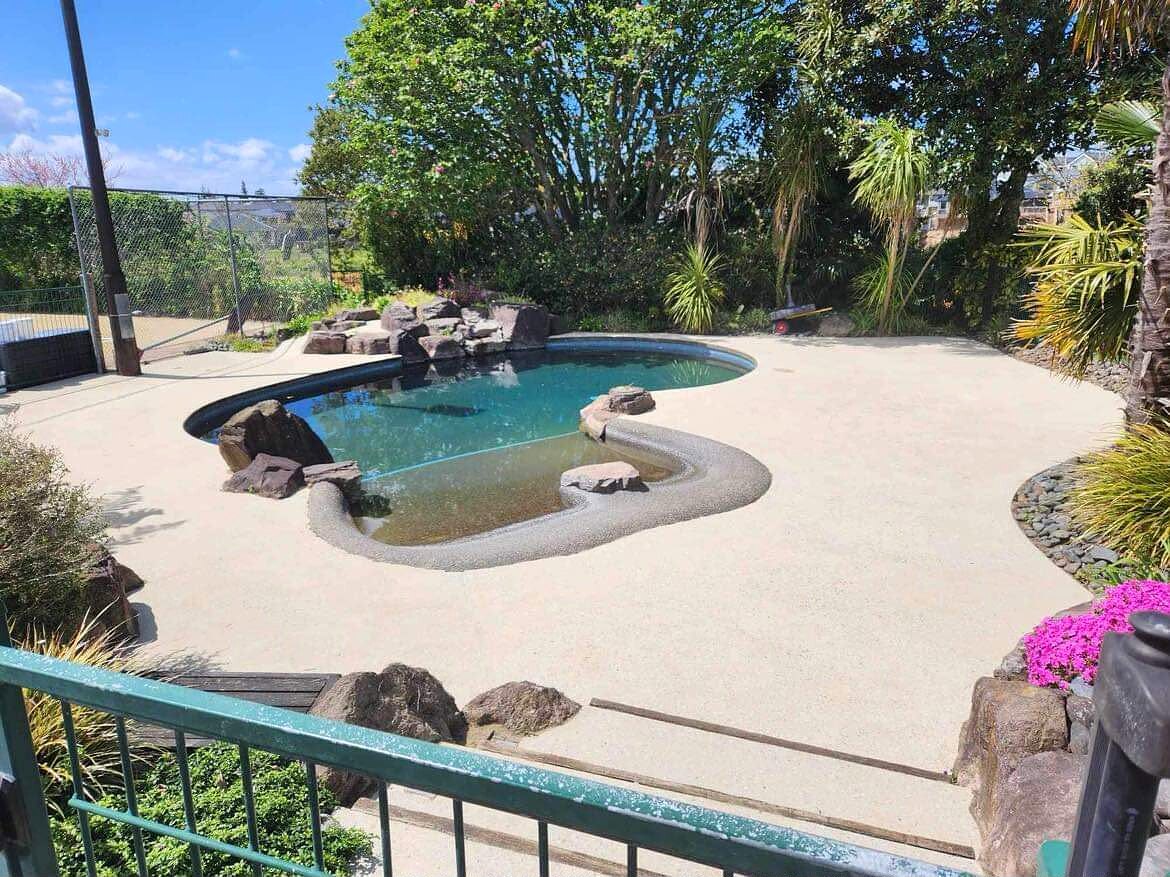
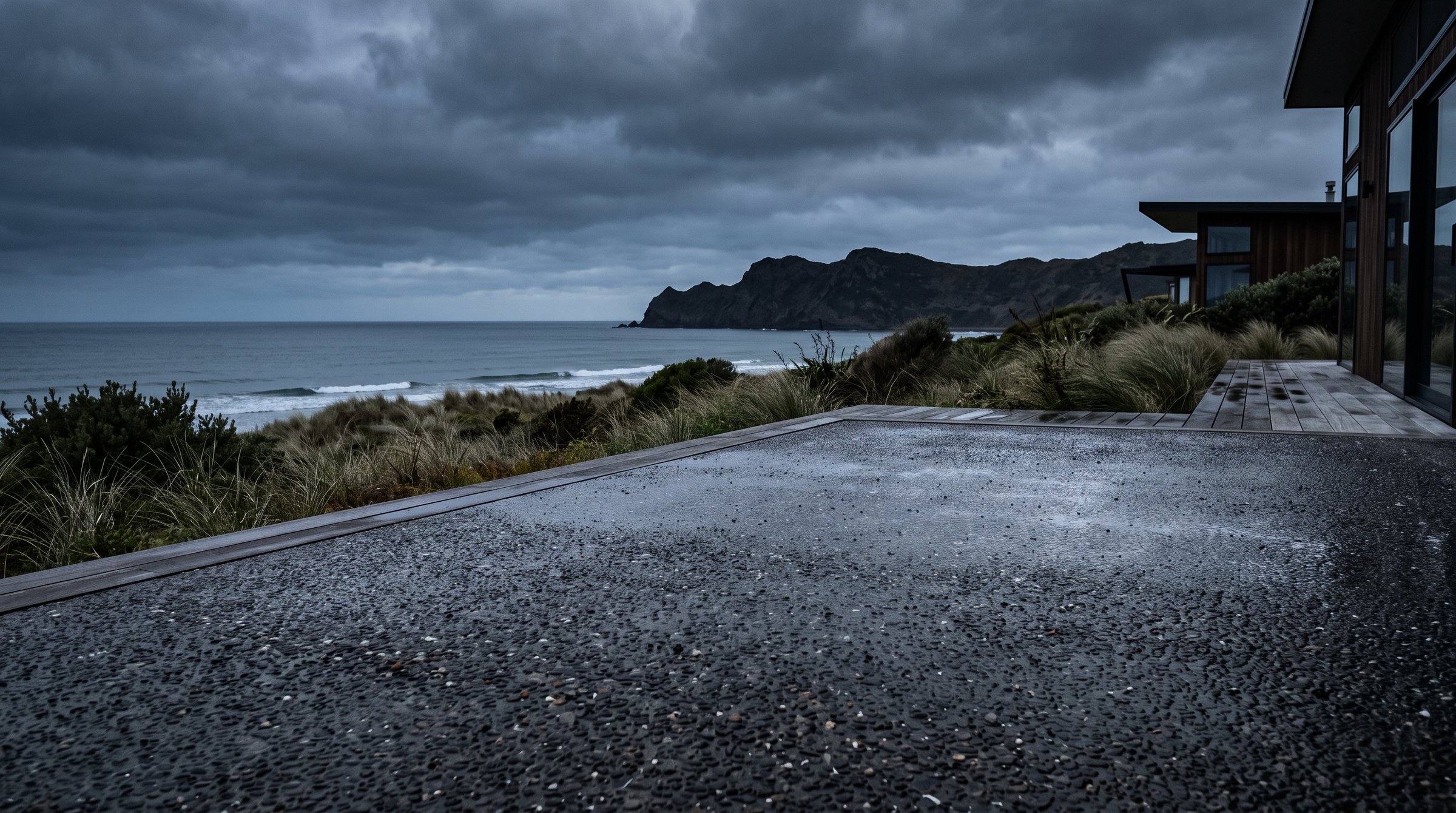
An existing slab that runs inside to outside can be treated as one surface, with the exterior section finished for grip rather than gloss.
Old slabs have history. Someone has run a pipe through and made it good. A wall has come out and the footing has been filled. A trench has been cut for a drain. All of it is invisible under carpet and all of it appears the moment the floor is ground.
Patched areas are different concrete. They cut differently, expose different aggregate and take sealer differently. They will be visible in the finished floor. On a lot of renovation jobs this is genuinely fine and reads as the history of the building, particularly at a heavier exposure where there is plenty going on in the floor anyway. On a job where a perfectly uniform floor is the expectation, it is a reason to consider a topping.
A topping is a new layer of polishable material bonded over the existing slab, generally somewhere between fifteen and fifty millimetres depending on the system. It gives you a fresh, uniform surface with an aggregate you choose, over a slab that could never have delivered that on its own.
It is the right answer where the existing slab is badly delaminated, where there is too little cover to cut into, where heavy contamination cannot be removed, or where the client genuinely needs a uniform floor that the existing concrete will not give.
It costs you three things, and they should be stated up front. Money, because a topping is a materially more expensive route than grinding what is already there. Time, because it has to be placed and then cured before it can be ground. And height, because the floor level rises, which affects door clearances, stair risers, thresholds and joinery. That last one catches people out on a renovation more than the cost does.
There are four variables in a polished concrete floor. Colour, aggregate, depth of cut and level of polish. On an existing slab, two of them were decided the day the concrete was poured and neither can be revisited.
Colour is in the mix. Oxide is dosed into the concrete at the plant, and there is no way to add it afterwards to a floor that is already down. A grey slab polishes to a grey floor. Topical stains and dyes exist and we do not offer them on this kind of work, because they sit in the surface, they wear at different rates in traffic paths, and they are a maintenance liability rather than a finish.
Aggregate is also in the mix. The stone that appears when we cut deeper is whatever the batching plant put in the truck years ago. In the Bay of Plenty that is generally a mid grey to brown river stone, which polishes well and looks good, but it is what it is. If you want a specific decorative aggregate, that is a decision for a new pour or a topping.
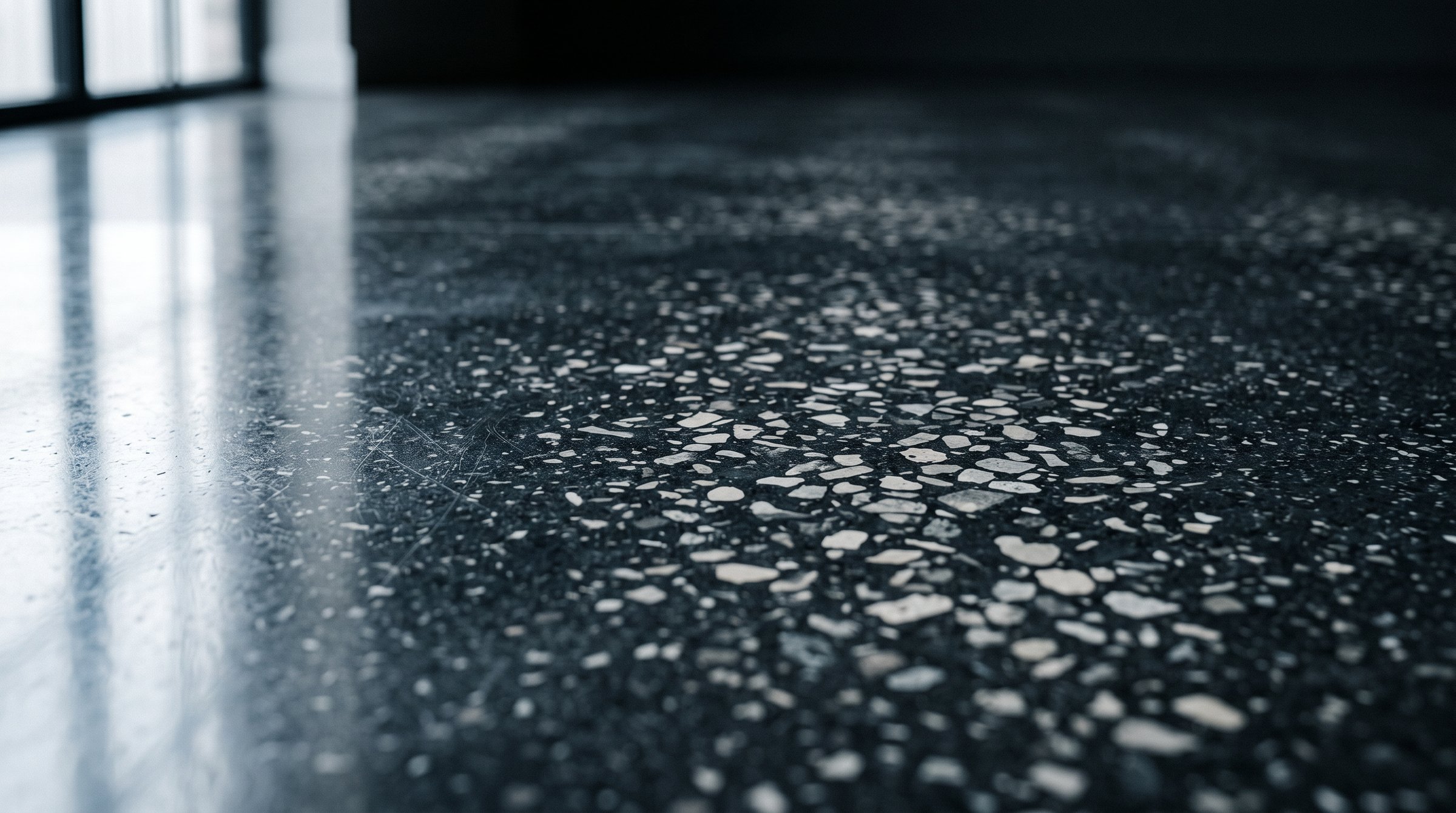
Colour like this is dosed into the mix at the pour. On an existing slab the colour you have is the colour you keep.
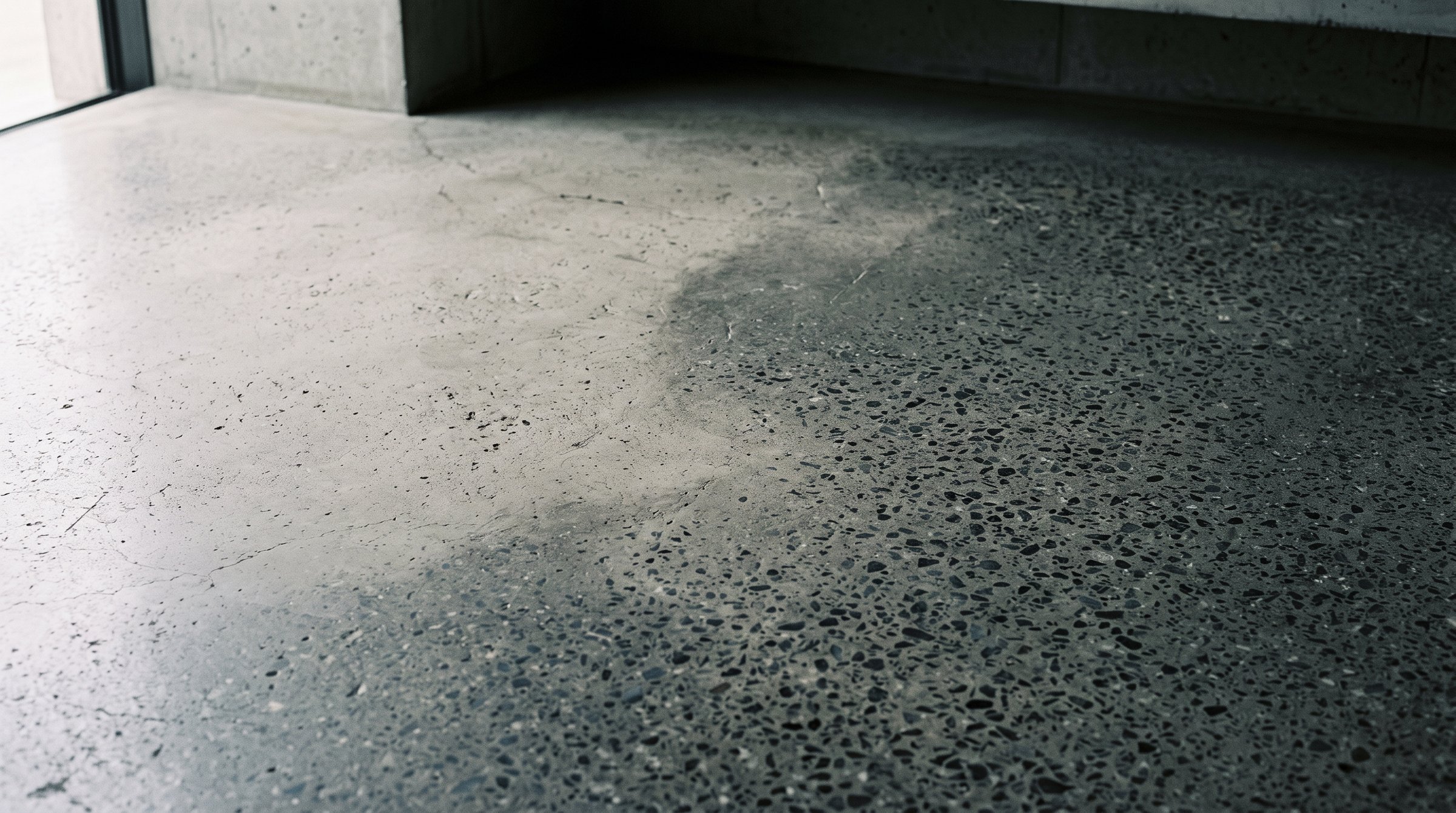
Depth of cut is fully open, and it is the biggest lever you have. Anywhere from a light cut that keeps the cement cream and the character of the old floor, through salt and pepper, to a full exposure with stone showing across the surface. Level of polish is also fully open, from a matte honed surface to a high gloss. Between those two you have far more control over the final look than most people expect.
Cracks do not disappear. That needs saying clearly because it is the most common source of disappointment on renovation work.
What we do is clean the crack out, fill it with a matched repair resin, and grind it flush so it is level, sound and sealed. What you get is a fine line in the floor rather than an open crack that collects dirt. Control joints and saw cuts are treated the same way and are also still visible afterwards.
On an old slab those lines are part of what the floor is. Clients who come to this expecting a poured resin surface are usually disappointed. Clients who come to it wanting a concrete floor to look like a concrete floor almost never are.
| What is on the floor now | Difficulty | Effect on the job |
|---|---|---|
| Carpet on smooth edge | Easy | Lift and go. Some nail hole filling, otherwise straight onto bare concrete |
| Glued carpet or vinyl | Moderate to hard | Adhesive has to be ground off. The type and thickness drive the labour and the tooling cost |
| Vinyl planks and floating floors | Easy | Usually laid loose over underlay, so the slab beneath is generally clean |
| Ceramic or porcelain tiles | Hard | Tiles and bed come off together, often taking slab surface with them and forcing a deeper cut |
| Epoxy or floor paint | Moderate to hard | Must be fully removed. A failed or thick coating is slow and unpredictable |
| Old sealer or wax | Easy to moderate | Comes off in the first passes. Usually adds little to the programme |
| Levelling compound or screed | Hard | Not polishable. Has to come off entirely, or the floor becomes a topping job |
| Black cutback adhesive | Specialist | Test for asbestos before disturbing it. Removal is a licensed job, not a grinding job |
Assessed on your floor before we quote. We lift a small area and cut a test patch rather than pricing a covering we have not seen the back of.
You cannot tell what aggregate is in a slab by looking at the top of it. You cannot tell how hard the concrete is, how the adhesive will behave, or how the colour will read once the surface comes off. A test patch answers all four in an afternoon.
We cut a small area, usually stepped so you can see two or three depths beside each other, and we wet it down so you can see roughly how it will look sealed. That gives you the actual floor, in your actual room, under your actual light. Every photograph on this site, and every photograph on any other site, is a different slab in a different building.
We do it somewhere that will end up under an island, in a wardrobe or behind a door, so the trial is not sitting in the middle of your finished floor.
There is no upper limit. Older concrete is often harder and cuts to a very good finish. What matters is thickness, cover over reinforcement, soundness and moisture, not the year it was poured.
No. The 28 day minimum applies to a new pour, because the concrete has to reach strength before it will cut cleanly. An existing slab is already there and can be ground at any time.
No. Colour is dosed into the mix at the pour and cannot be added afterwards. What you can change is the depth of cut and the level of polish, and both make a substantial difference to how the floor reads.
No. Cracks are cleaned out, filled with a matched resin and ground flush, so they end up as fine lines that are level and sealed rather than open. Control joints and saw cuts also remain visible. That is a characteristic of an existing slab, not a fault in the work.
Extraction runs at the head, so the dust is captured as it is created rather than swept up afterwards. The space still needs to be empty and sealed off from the rest of the house, but the process is not the open dust cloud people remember.
It varies too much with adhesive removal, slab condition and area for a number to be useful here. What we can say is that the removal work is where the variation lives, which is why we test patch first and give you a price based on what is actually under the covering.
Coating removal, grind back, densify and seal on a slab you already have.
Adhesive removal and progressive cutting with dust extraction at the head.
Why colour is decided at the pour and what that means for an existing slab.
Price a floor
A few pertinent questions about your slab and space.
Step 1 of 6
Your own slab answers more than another thousand words.
Site assessment and written quote, no obligation.

Tell us about the slab and we will tell you what it can do.
Site assessment and written quote, no obligation.