Outdoor

Outdoor
Approved PeterFell C2 Applicator
Approved TextureSafe Applicator
Twenty-Five Years Combined Experience
Grinding Dynamics
Published 17 August 2026 · 9 minute read
Concrete on the coast lives a harder life than concrete anywhere else in the country, and sealers on the coast fail faster than the sealer tin suggests. That is not a fault in the product. It is what happens when you put a thin protective layer between a porous slab and an environment that is throwing salt, sand and ultraviolet light at it every day of the year.
We work Mount Maunganui, Papamoa, Omokoroa, Bethlehem, Te Puke, Katikati and Whakatane, and the pattern is consistent. Two identical driveways, one four streets back from the dunes and one twenty minutes inland, will be in different condition at the same age. If you own concrete near the water it is worth understanding why, because it changes what you should ask for and how often you should expect to spend money on it.
Salt arrives as an aerosol. Onshore wind picks up spray, carries it inland and deposits a fine chloride film on every horizontal and vertical surface it reaches. You do not need to be able to see the sea for this to be happening. Rain washes some of it off, dew redissolves the rest, and the cycle repeats.
On concrete itself the concern is not the surface. Sound, well compacted concrete is reasonably tolerant of salt. The problem is that chlorides travel through the pore structure with water, and where they reach embedded steel they break down the passive layer that protects it. Corroding steel expands, and expanding steel cracks concrete from the inside. That is the mechanism behind most of the coastal concrete damage you see in older properties, and it is a durability issue rather than an appearance issue.
On the sealer, salt behaves differently. Salt crystals form in the pores as water evaporates, and crystal growth exerts real pressure inside a coating that is bridging those pores. A film sealer over a salt loaded surface is being pushed off from underneath. This is one of the reasons film forming products are less reliable in a marine setting than they are inland.
On the coast a sealer is a consumable, not a permanent finish.
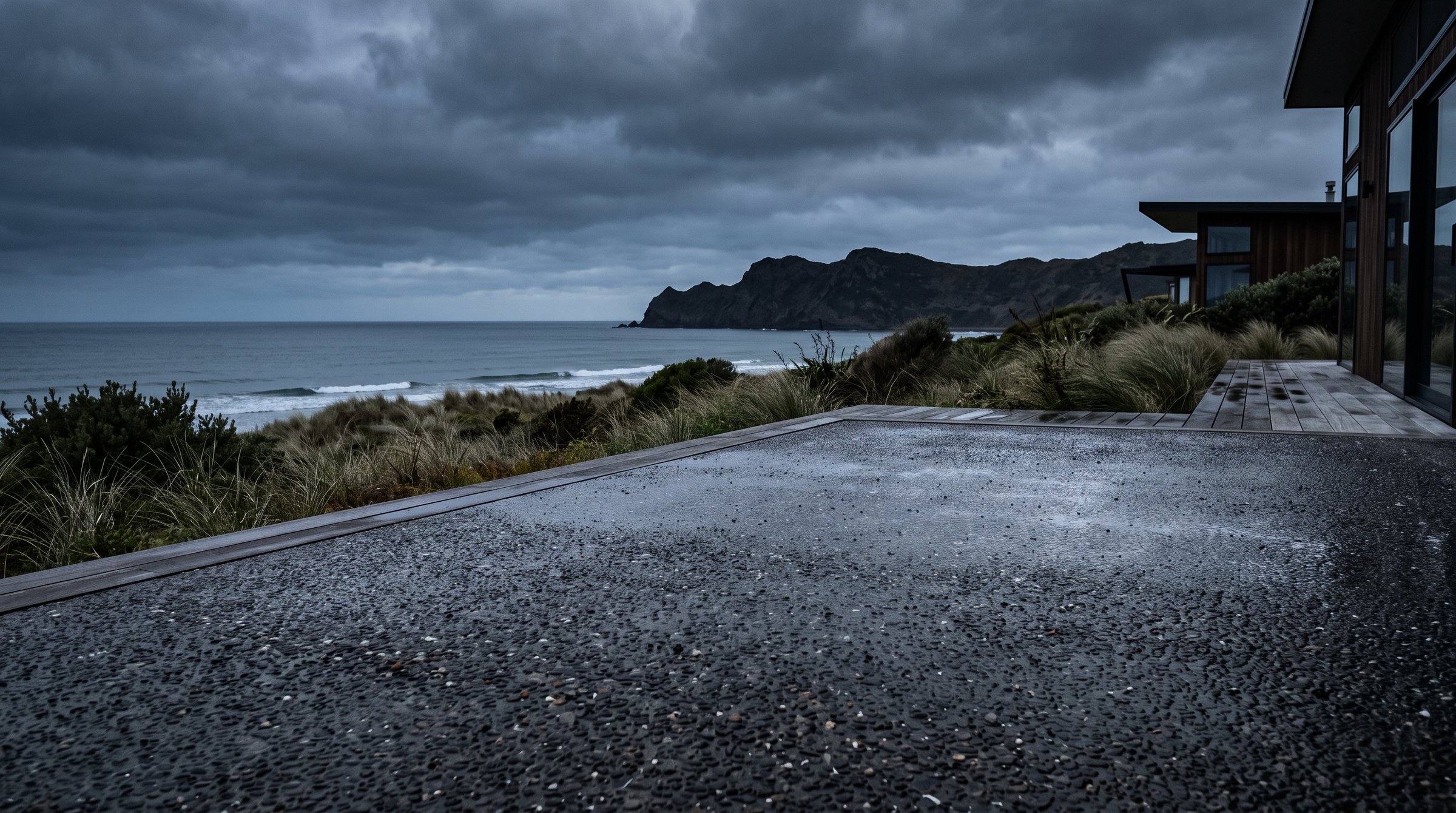
Sand is the part people underestimate. On an exposed Papamoa or Mount Maunganui site the wind carries fine sand more or less permanently, and every grain that lands on a deck, a pool surround or a driveway becomes an abrasive under foot traffic. A sealer does not wear evenly under those conditions. It wears along the walking lines, at the door thresholds, on the steps and around the pool coping, and it survives in the corners where nobody walks.
That is why coastal sealer failure often looks like a map of how the house is used. The sealer has not failed chemically. It has been sanded off where people walk and left where they do not, which is also why patch recoating never looks right.
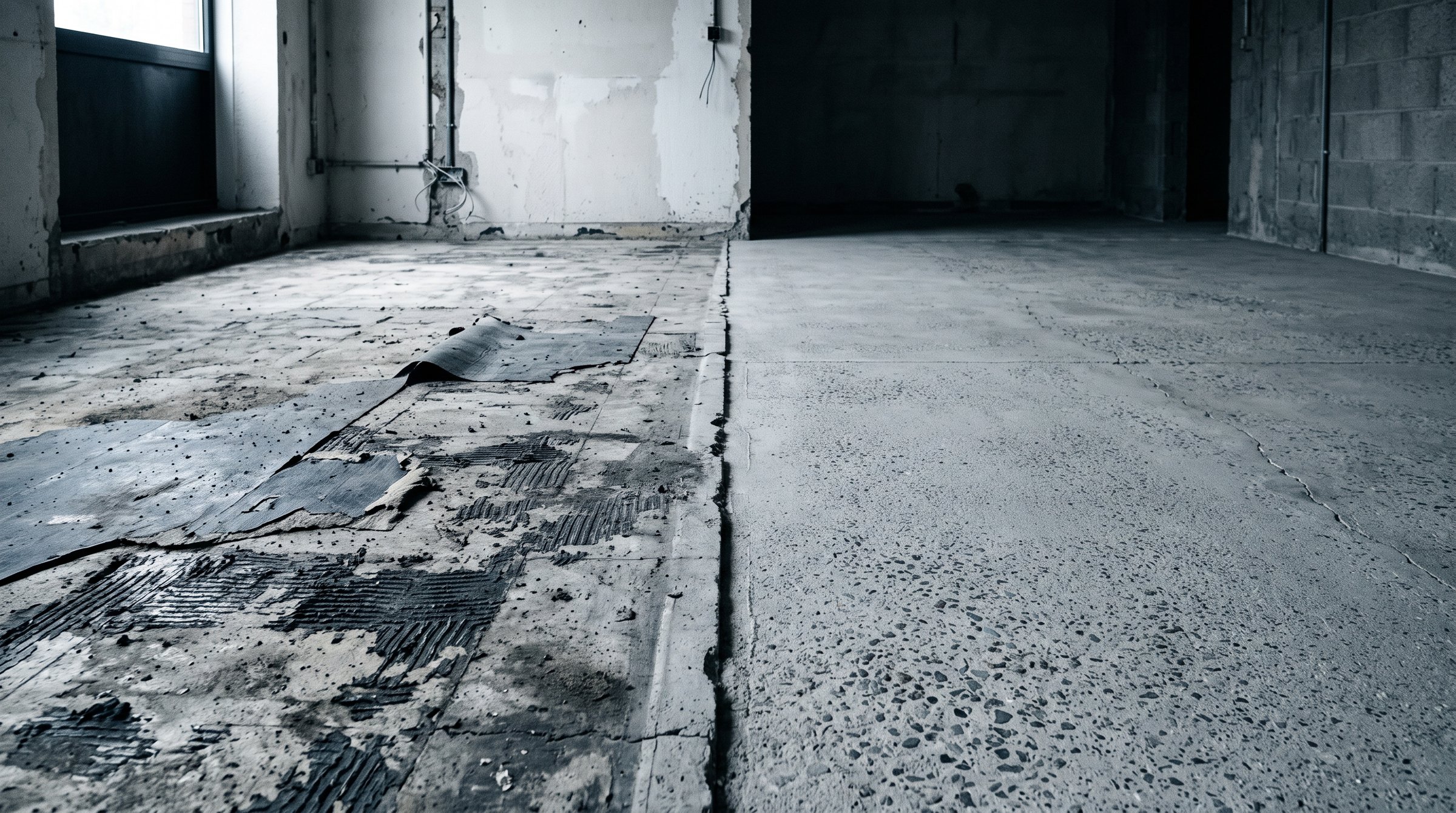
Where an interior floor runs out to an exterior surface, the outside half is on a completely different maintenance cycle to the inside half.
Ultraviolet light breaks the polymer chains in an organic coating, and that applies to every sealer on the market to some degree. As the chains break, the film loses flexibility and adhesion, and you get chalking, dulling and eventually flaking. New Zealand ultraviolet levels are high, so a product tested elsewhere can behave worse here.
This is the point most people need to accept before they spend money. An exterior sealer is a maintenance item with a service life, in the same category as exterior paint. It is not a one off improvement to the property. If someone tells you a sealer on a coastal driveway is permanent, they are either selling something or they have not gone back to look at their own work.
Standing water is the other accelerant. Where a surface does not drain, water sits, salt concentrates as it evaporates, and any coating in that area is under load for far longer than the rest of the surface. Ponding on a driveway or a poorly falling patio will show sealer failure first, every time.
Shade compounds it. A south facing surface, or one under trees or a deck overhang, dries slowly and stays damp. Damp concrete grows lichen, moss and algae. Organic growth holds moisture against the surface, roots into the pores, and on a sealed surface it lifts the film from beneath. It is also the main slip risk on coastal exterior concrete, well ahead of the sealer itself.
A penetrating sealer soaks into the pore structure and works from inside the concrete. It reduces water and chloride absorption without putting a layer on top. It does not change the look much, it does not peel, it does not go milky, and when it eventually wears out it simply stops working rather than failing visibly. On exposed coastal exterior concrete this is usually the right answer.
A film forming sealer sits on the surface as a coating. It can enrich colour, add sheen and give a wipeable surface, which is why it is common indoors and on sheltered surfaces. Outdoors on the coast it is carrying every problem described above at once, salt pressure from underneath, sand abrasion from above and UV from overhead.
Be clear about the trade off. A failing film is worse than no film at all. Bare concrete that has weathered still looks like concrete. A film that has whitened, blistered and started peeling looks like neglect, and it costs money to remove before anything else can be done. That removal cost is real and it is the reason we are cautious about specifying films on exposed exterior surfaces.
| Surface | Exposure | What shortens sealer life | Typical approach |
|---|---|---|---|
| Coastal driveway | Full sun, salt aerosol, vehicle traffic | UV, tyre scuff, hot tyre pick up on films, grit ground in under wheels | Penetrating sealer, reapplied on a maintenance cycle, no film |
| Pool surround | Salt or chlorinated water, bare feet, sun | Constant wetting and drying, sunscreen and pool chemistry, wind blown sand | Textured surface with a penetrating sealer, grip prioritised over sheen |
| Exposed deck or patio | Full weather, furniture, wind driven sand | Abrasion along walking lines, furniture drag, ponding at low points | Penetrating sealer, drainage corrected first, reseal by wear not by calendar |
| Shaded or south facing path | Damp, slow drying, organic growth | Lichen and moss rooting into pores, moisture held against the surface | Clean and treat growth, penetrating sealer, expect regular washing |
| Sheltered indoor outdoor flow | Roofed, partial sun, foot traffic only | UV at the open edge, tracked in grit at the threshold | Film only where genuinely sheltered, and accept a visible line where cover ends |
| Garage or carport slab | Covered, vehicle fluids, occasional wetting | Oil and fuel, hot tyres, water carried in off the driveway | Sealer chosen for chemical resistance rather than weathering |
Exposure varies street by street on the coast, so this is a starting point for a conversation on site rather than a specification.
We give resealing intervals as ranges, and we tie them to exposure rather than to a number on a calendar. A sheltered, shaded path with light foot traffic can run for years. An exposed north facing driveway two streets from the beach will be due considerably sooner than the same driveway in Bethlehem or out past Te Puke. Anyone who quotes you a single fixed interval without seeing the site is guessing.
The practical approach is to inspect rather than to schedule. Tip a cup of water onto the surface. If it beads and sits, the sealer is still working. If it darkens the concrete and soaks in within a minute or two, the sealer has stopped doing its job in that area and it is time. Check the worst exposed area, not the sheltered corner, because the worst area sets the timing.
With a penetrating sealer there is nothing to see. It just stops repelling water, and that is the whole signal. With a film there is plenty to see, and it is worth learning to read it.
None of that is fixed by another coat. Sealer bonds to what is underneath it, so a new coat over a failing film bonds to a failing film and comes off with it, usually faster than the original did because you have now trapped more moisture. It also seals in the whitening, which then sits permanently under a fresh gloss layer.
A failed film has to come off mechanically. That means grinding the surface back to sound, clean, open concrete. On a textured exterior surface that can also mean a mechanical clean that respects the profile rather than flattening it. Chemical strippers have a place on small areas, but on a driveway or a full pool surround the machine is faster, more thorough and does not leave residue behind that interferes with the new sealer.
Once the old coating is off, the surface has to be washed properly to remove salt, and then dried. This is not optional on the coast. Sealing over a salt film puts the crystal growth problem straight back under the new coating, and you have bought yourself the same failure again.
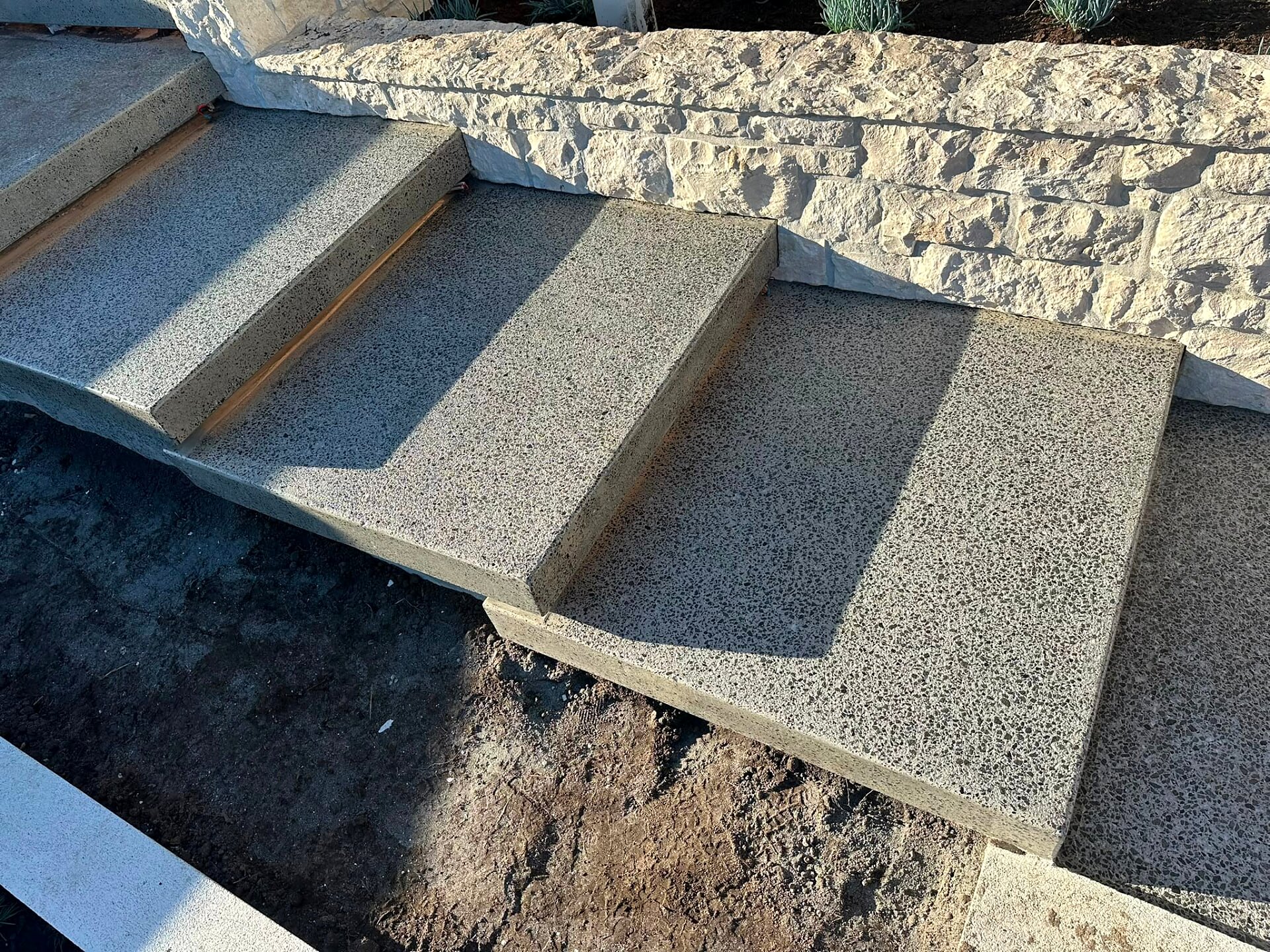
On steps and pool surrounds the profile is the safety feature. Preparation has to clean the surface without flattening the texture out of it.
Sealer application is weather dependent, and the cure window is where jobs get ruined. Three conditions matter. Surface temperature, because most products have a minimum below which they do not form properly and a maximum above which they flash off before they can penetrate. Overnight dew, because moisture landing on an uncured film causes exactly the whitening described above. And rain inside the cure window, which can lift or wash a fresh coat straight off.
In practice that means we do not seal exterior work late in the day in the cooler months, because the surface will be wet with dew hours after the sun goes. It means we watch the forecast rather than the diary. And it means we would rather push a sealing day than apply into conditions that will not let the product cure, because the cost of doing it twice is entirely ours.
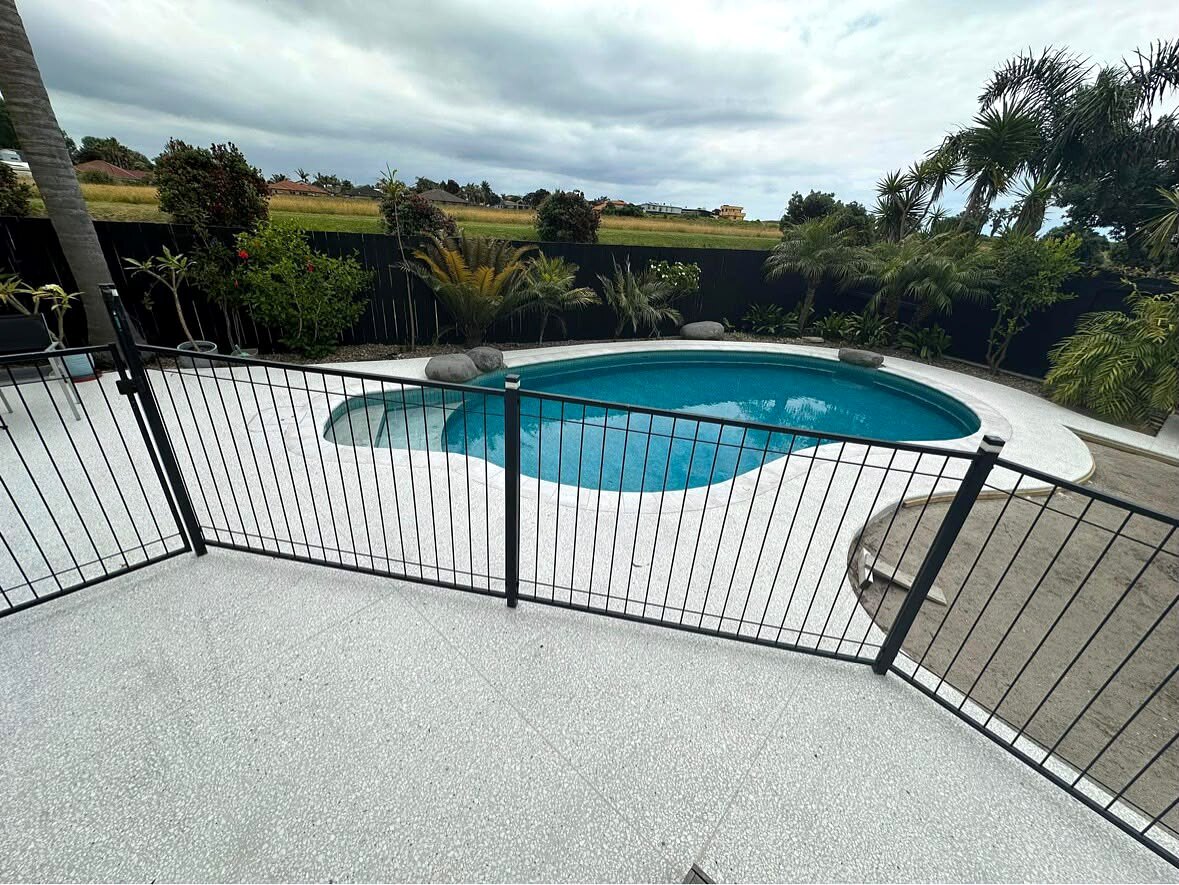
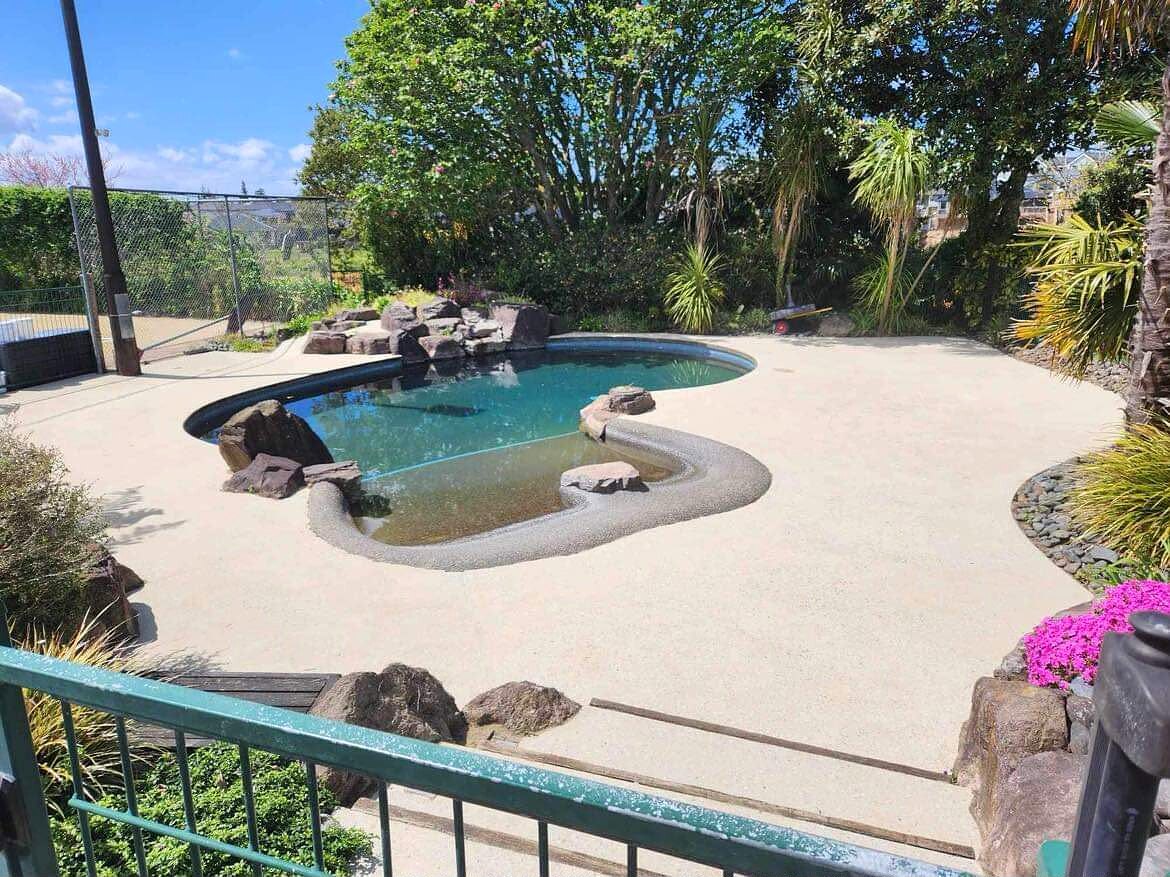
Pool surrounds combine every coastal problem with a safety requirement. Slip resistance has to come from the surface profile, from texturing or bush hammering, and the sealer must not fill or gloss over that profile.
Look at the surface honestly. If there is a failing film on it, budget for removal before a new coat. If it is bare and porous, a penetrating sealer applied properly is durable money well spent. If it ponds, fix that first.
It depends on exposure, so we give a range rather than a figure. A fully exposed driveway near the dunes needs attention considerably sooner than a sheltered, shaded path inland. The reliable test is water. When water soaks in and darkens the concrete instead of beading, the sealer has stopped working in that area and it is time.
No. A new coat bonds to whatever is underneath it, so if the existing film is lifting, chalking or whitening, the new coat fails with it and usually faster. A failed film has to be removed mechanically back to sound concrete before anything goes back on.
Sound concrete tolerates salt at the surface reasonably well. The durability concern is chlorides travelling through the pore structure with water and reaching the reinforcing steel, because corroding steel expands and cracks the slab from within. Reducing water absorption is the main thing a sealer does for you on the coast.
Yes, and it is the main reason we move dates. Surface temperature has to be inside the product range, there must be no rain in the cure window, and the surface must not pick up overnight dew before the sealer has cured. Applying into the wrong conditions causes whitening and adhesion failure.
Pool surrounds are treated as a grip problem first and a sealing problem second. The surface profile provides the slip resistance, and the sealer is chosen so it does not fill or gloss that profile. Constant wetting and drying plus pool chemistry means these surfaces are on a shorter maintenance cycle than most.
A film forming sealer with a gloss finish can reduce grip when wet, which is why we avoid them on pool surrounds, steps and ramps. Penetrating sealers leave the surface profile alone, so they change the appearance and the grip very little.
Penetrating and film forming sealers, resealing cycles and failed coating removal.
Bush hammered and textured exterior surfaces where grip matters more than gloss.
Price a floor
A few pertinent questions about your slab and space.
Step 1 of 6
Your own slab answers more than another thousand words.
Site assessment and written quote, no obligation.

Tell us about the slab and we will tell you what it can do.
Site assessment and written quote, no obligation.