
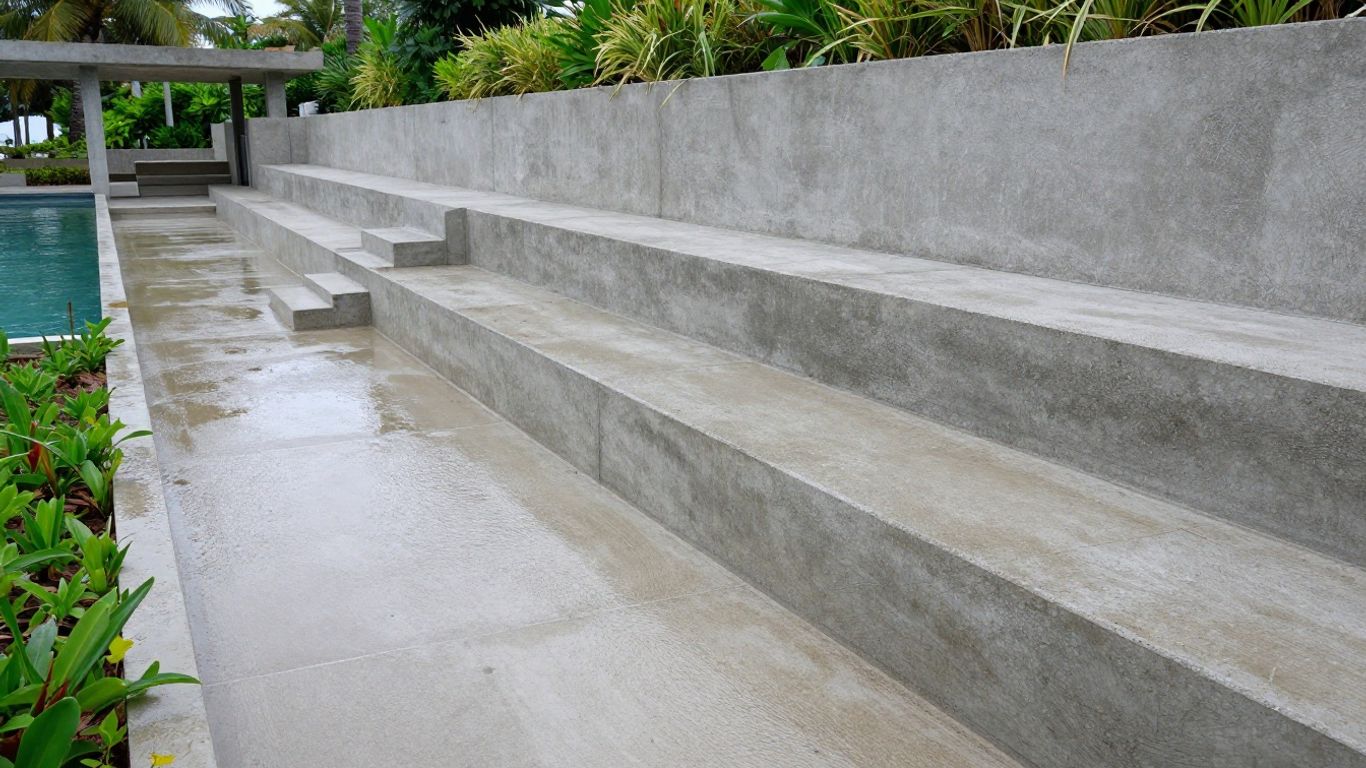
Wet grip concrete finish: How to create a safe, durable, slip-resistant surface
Create a wet grip concrete finish with the right texture, preparation, testing, and maintenance.
Published 25 August 2026
Key Takeaways
A wet grip concrete finish is designed to keep walking surfaces more secure when water, oils, or pool chemicals reduce friction. The best result comes from matching the texture, preparation, application method, and maintenance plan to the site.
- Choose texture according to how the area will be used and cleaned.
- Repair, clean, and profile the concrete before applying any finish.
- Use anti-slip additives carefully so traction remains even and comfortable.
- Check wet performance on site rather than relying only on a dry feel.
- Maintain drainage, joints, edges, and worn areas as part of the safety plan.
What a wet grip concrete finish is and where it works best
A wet grip concrete finish gives water a way to move across or away from the walking surface while creating more texture for footwear to engage with. It may be formed in fresh concrete, exposed by finishing, cut into an existing slab, or added through a compatible sealer or coating system. The right answer depends on the slab, the traffic, the appearance required, and how often the surface will be wet. A polished interior floor and a pool surround may both be concrete, but they need very different surface decisions.
How wet grip differs from a standard concrete finish
A standard smooth finish can feel perfectly secure when dry and become unexpectedly slick when water fills its small surface irregularities. A wet grip concrete finish introduces a more deliberate profile, whether through broom marks, exposed aggregate, bush hammering, or a textured additive. That profile should be consistent rather than harsh, because isolated ridges can create their own problems. Wet traction is a system, not simply a rough-looking surface.
The finish also needs to remain practical under cleaning and regular use. Dust, algae, grease, soap residue, and worn sealer can reduce the benefit of texture, so the surface should be assessed in the condition in which people actually use it. A sample area is useful for checking both grip and appearance before committing to the whole slab.
Indoor and outdoor areas that need extra traction
Wet grip is especially relevant around swimming pools, outdoor showers, entrances, ramps, steps, sloping paths, driveways, and covered walkways exposed to rain. Commercial kitchens, plant rooms, changing areas, and service corridors may need similar attention, although cleaning chemicals and wheeled traffic can change the specification. Garages and workshops also deserve care when water, oil, or fine dust is regularly tracked across the floor.
In the Bay of Plenty, coastal moisture, salt, strong sun, and frequent outdoor exposure can all influence the finish selected. Grinding Dynamics’ non-slip concrete texturing guidance is relevant where grip needs to be created within the concrete rather than treated as a temporary film on top. The surface still needs suitable drainage and routine cleaning; texture does not compensate for standing contamination.
Balancing slip resistance with comfort and appearance
More texture is not automatically safer. A very coarse profile may be uncomfortable under bare feet, difficult to mop, noisy under wheels, or prone to holding dirt. Conversely, a surface that looks elegant but loses friction when wet may not be suitable for a pool edge or ramp. The best finish has enough profile for the risk without making ordinary movement and maintenance unnecessarily difficult.
For a decorative project, assess the finish in natural light and under wet conditions. Aggregate colour, aggregate size, depth of exposure, sheen, and sealer choice can all change the visual result. On an existing slab, a test grind or test texture is more dependable than a catalogue photograph because the slab’s mix and placement history remain visible in the finished surface.
When a coating, sealer, or textured finish is the better choice
A textured finish formed directly in sound concrete is often a durable option for a new slab or an existing surface that can be profiled. A sealer can protect concrete from water, staining, salt, and wear while retaining the appearance of the substrate. A coating may be useful where colour changes, repair concealment, or a specified build thickness is required, but it must be compatible with the concrete and the intended traffic.
Do not use a film-forming product to hide unresolved moisture, contamination, movement, or loose concrete. Those conditions can cause peeling or uneven wear regardless of the additive used. The decision should begin with the slab and the site conditions, then move to appearance and product selection.
Choosing the right texture and traction system
Texture is a performance decision as much as a design choice. A finish that works for a lightly used patio may be unsuitable for a vehicle ramp, public entrance, or constantly wet pool deck. Consider the direction and intensity of traffic, bare feet versus footwear, cleaning equipment, drainage, weather, and the expected service life. Samples should be large enough to feel underfoot and inspect when wet.
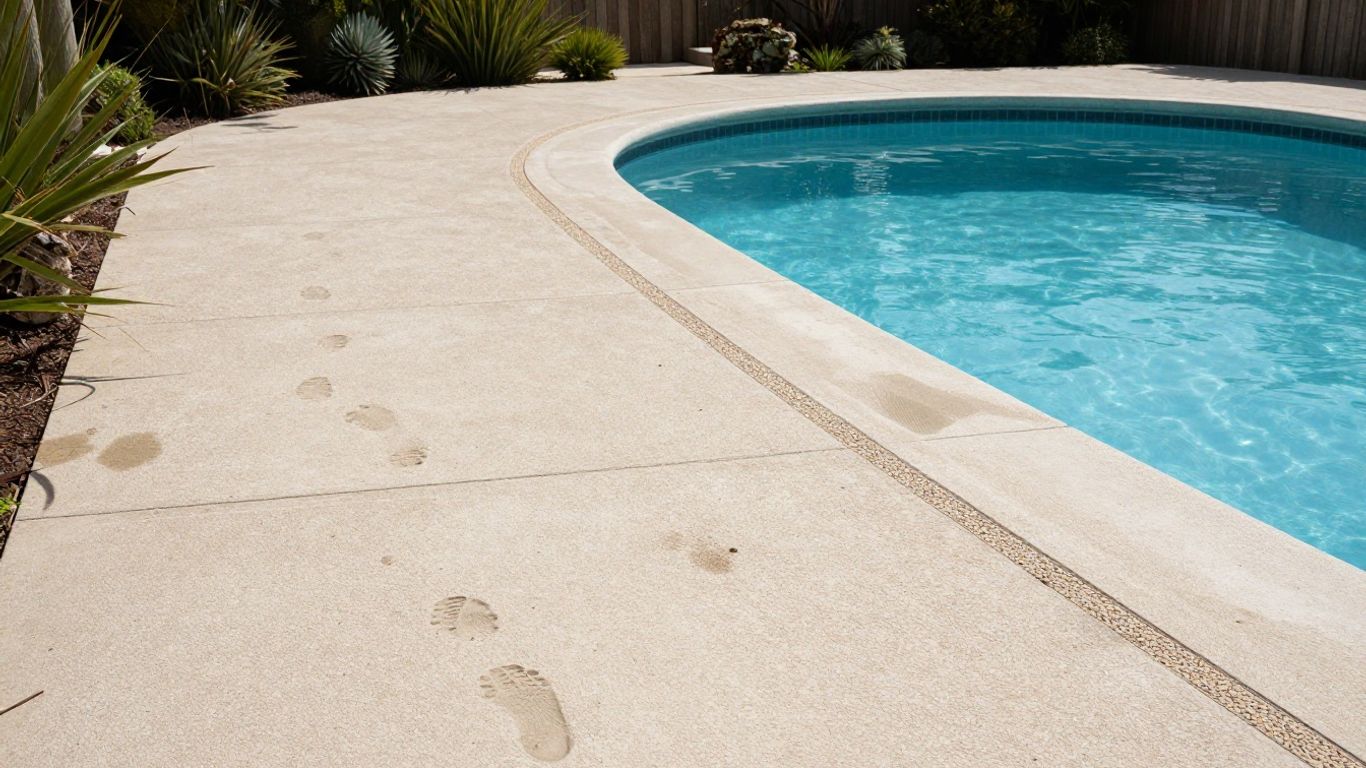
Broom, exposed aggregate, and stamped concrete options
A broom finish creates shallow, directional grooves while the concrete is fresh and is usually straightforward to maintain. Exposed aggregate provides texture through the stone itself, with the amount of exposure affecting both grip and visual character. Stamped concrete can reproduce patterns and materials, but the relief must be designed so it does not create uncomfortable ridges or difficult-to-clean recesses.
On an existing slab, mechanical texturing may be more appropriate than trying to recreate a fresh-concrete finish. Grinding Dynamics describes the PeterFell TextureSafe System as a method that cuts a permanent, non-slip profile directly into the concrete. That is a different approach from relying on a removable or wearing coating, and the profile can be varied between higher-risk zones and areas where barefoot comfort matters more.
Slip-resistant additives for sealers and coatings
Fine mineral or polymer grit can be mixed into a compatible sealer or coating to increase surface texture without substantially changing the underlying colour. The additive must remain distributed through the material rather than sinking, clumping, or being brushed away during application. Always follow the product’s mixing guidance, including the recommended loading, pot life, and recoat process.
The sealer itself still has to suit the slab and environment. A product designed for exterior concrete may respond differently to moisture, ultraviolet exposure, pool chemicals, or vehicle traffic than an interior floor sealer. Test the complete system—not just the grit—on a small area before broad application.
How aggregate size affects grip and cleanability
Larger exposed aggregate can create pronounced contact points and a visually stronger finish, while smaller aggregate tends to provide a more even walking surface. Large stones and deep recesses may collect leaves, soil, and cleaning residue, especially where drainage is poor. Fine texture is easier to clean but may offer less mechanical engagement once a film of water or contamination sits on it.
The useful compromise depends on the risk. A pool step may need more pronounced traction than the centre of a deck, while a commercial entrance may need a texture that tolerates frequent scrubbing and wheeled traffic. A sample tile or test area lets users judge the balance with their own hands and feet instead of choosing from a screen image.
Selecting a finish for foot traffic, vehicles, or pool areas
Foot traffic calls for a surface that is secure without being abrasive. Vehicle areas need attention to tyre loading, turning forces, oil contamination, snow or rain exposure where relevant, and the possibility of tyre noise. Pool areas add bare feet, constant moisture, sunscreen, cleaning chemicals, and sharp transitions around coping and steps.
A simple use-based comparison can keep the selection grounded:
| Area | Main traction concern | Useful finish direction | Maintenance priority |
|---|---|---|---|
| Pool surround | Bare feet and standing water | Comfortable, continuous texture | Remove oils, algae, and residue |
| Sloping path | Water movement and downhill travel | Consistent profile with good drainage | Inspect worn routes and edges |
| Garage or workshop | Oil, dust, and vehicle loading | Durable textured sealer or concrete profile | Degrease promptly and inspect wear |
| Commercial entrance | Heavy foot traffic and tracked rain | Even, cleanable traction | Frequent cleaning and entry matting |
The table is a starting point, not a specification. Confirm the finish against the actual slope, drainage, cleaning routine, and accessibility needs before installation.
Preparing the concrete before applying the finish
Preparation determines whether a wet grip concrete finish bonds, remains even, and performs for its expected service life. New and existing slabs have different concerns, but neither should be treated as a blank canvas. Moisture, laitance, oil, old sealer, cracks, and unevenness can all interfere with the result. A careful inspection usually saves more time than trying to correct a failed finish later.
Checking the slab for damage, moisture, and contamination
Start by mapping cracks, hollow-sounding areas, spalls, stains, joints, and changes in level. Look for oil, grease, paint, plaster, adhesive, curing compounds, efflorescence, and previous sealers. Moisture testing matters particularly where a coating or film-forming sealer is being considered, because trapped vapour can create blistering or poor adhesion.
The existing slab also controls the final appearance. Construction contamination and uneven finishing can remain visible after grinding or sealing, as explained in this guide to patchy polished concrete. Do not promise a uniform outcome until the concrete has been inspected and a representative test area has been reviewed.
Repairing cracks, spalls, and uneven areas
Repair materials should be chosen according to crack movement, depth, traffic, and the final finish. Loose concrete must be removed, weak edges cut back, and repairs allowed to cure as directed. A repair that sits proud of the slab may become a visible ridge after texturing, while a low repair can hold water and dirt.
Non-structural hairline cracking may remain part of the slab’s character, but active or wide movement requires a more careful assessment. Grinding can remove high spots and old surface build-up, yet it cannot correct every structural problem. If the substrate is too thin, deeply contaminated, or unstable, replacement or a suitable topping may be more sensible than forcing a finish onto it.
Cleaning and profiling smooth concrete
Cleaning removes contaminants; profiling creates the surface condition needed for the selected system. Depending on the concrete and product, preparation may involve mechanical grinding, shot blasting, scarifying, or controlled abrasion. Acid etching alone is not a universal substitute for mechanical preparation, particularly where old coatings or oily contamination are present.
Grinding Dynamics uses dust-controlled concrete grinding services to prepare concrete, remove old finishes, level high spots, and create a suitable ground-and-sealed surface. The method should be matched to the slab rather than selected for convenience. After preparation, vacuum thoroughly and confirm that the surface is clean, sound, and free of loose dust before proceeding.
Planning around weather, curing, and surface temperature
Fresh concrete needs sufficient curing before a finish is applied, and the product instructions should determine the timing. For polishing work, the documented project approach from Grinding Dynamics calls for a minimum 28-day concrete age before polishing; textured or sealed work may have different requirements. Existing slabs still need a moisture and weather assessment, especially outdoors.
Avoid applying sealers or coatings when rain, dew, extreme heat, freezing conditions, or rapidly falling temperatures could affect curing. Surface temperature can matter as much as air temperature. Plan edges, access, shade, and protection so the finish is not walked on, contaminated, or exposed to water before it has developed adequate strength.
How to apply a wet grip concrete finish
Application should be controlled from the first pass to the final inspection. The goal is a consistent texture with no slick islands, heavy ridges, thin edges, or unsealed pinholes. Follow the chosen system’s technical data and work to a wet-edge plan where required. Keep a sample or reference area available so the crew can compare colour, texture, and coverage as the work proceeds.
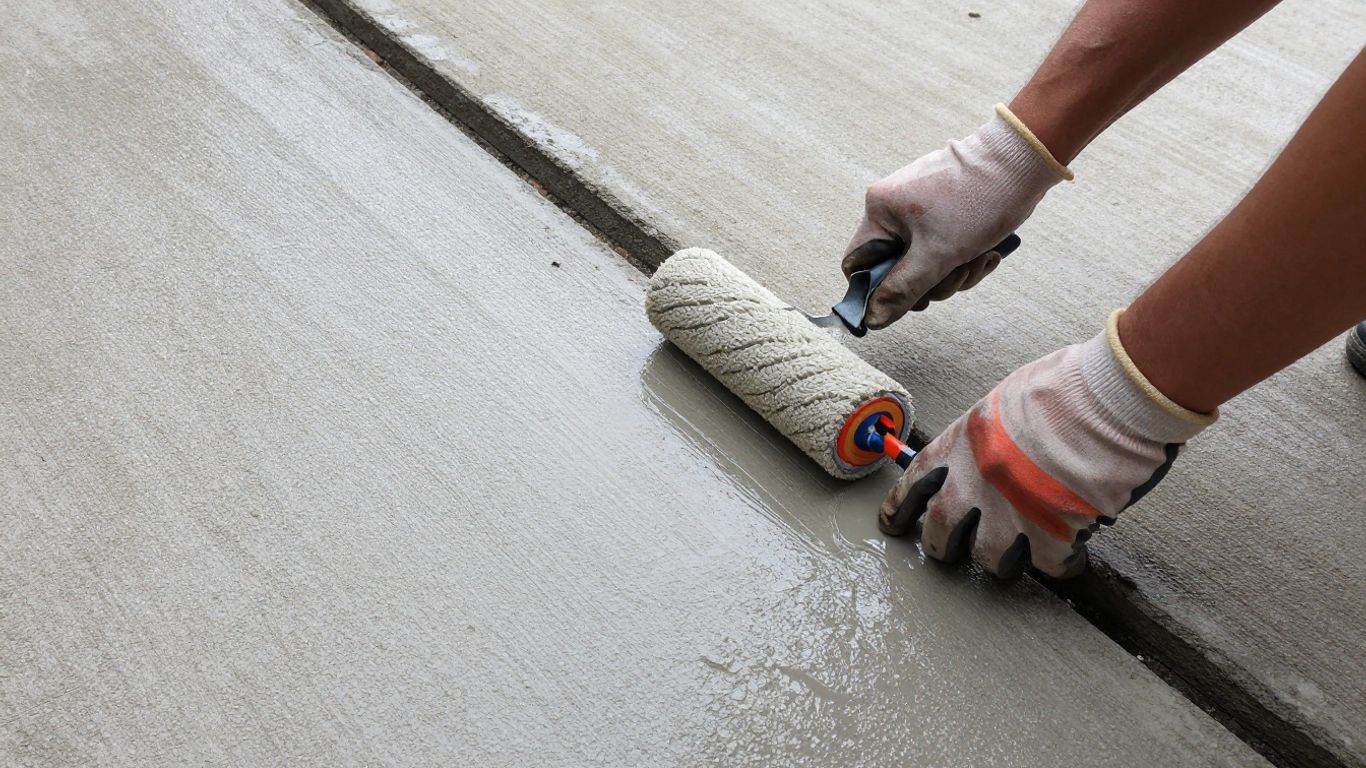
Creating traction in fresh concrete
Fresh concrete offers several ways to form traction, including brooming, exposed aggregate, and patterned finishing. Timing is critical: too early and the surface may tear or collect paste; too late and the desired profile may not form evenly. The direction, pressure, and overlap of broom strokes should be kept consistent across adjoining pours.
Control joints and day joints need particular care so the texture does not stop abruptly or create a raised lip. Protect the surface during curing and keep later trades from depositing plaster, paint, rust, or oil. A good fresh finish can still be compromised by poor site protection.
Mixing anti-slip additives into sealers or coatings
For a sealer or coating system, disperse the anti-slip additive according to the manufacturer’s instructions and keep the mixture moving when necessary. Too little additive may leave wet areas slick; too much can produce an abrasive, cloudy, or difficult-to-clean surface. Compatibility is essential, particularly when switching between water-based and solvent-based materials.
The slip-resistance guide explains why dry laboratory readings do not always describe how a surface behaves when wet and contaminated. That is a useful reminder to test the complete installed system. Record the product batch, additive amount, application rate, weather, and substrate condition so future repairs can match the original work.
Applying the material evenly without creating weak spots
Apply the material at the specified coverage rate using equipment suited to the product and slab. Overworking a sealer can move grit away from high points, while insufficient coverage may leave porous or visually inconsistent areas. Edges, corners, and patched sections often absorb material differently, so they need deliberate checking rather than a quick final pass.
Work in manageable sections and keep the finish continuous at natural breaks. After the first coat or texture pass has cured as directed, inspect for bare spots, pooling, fish-eyes, debris, and unwanted marks. Correct problems while they are still compatible with the next stage instead of burying them under another coat.
Managing edges, joints, slopes, and transition areas
Slopes should drain water rather than directing it toward a doorway or low point where people stand. At thresholds, stairs, ramps, and changes in finish, keep the transition flush and visually clear. Texture should not create a trip edge at a joint or disguise a change in level.
Edges often receive less material than the centre because rollers and brooms cannot reach them easily. Use suitable hand tools and protect adjacent walls, coping, drains, and landscaping. On ramps and steps, consider the travel direction and handrail locations when deciding how the texture should run.
Testing slip resistance and meeting safety needs
A finish should be judged under the conditions that create the risk. A dry hand test can identify obvious roughness, but it cannot prove safe wet performance. Water depth, footwear, contamination, slope, cleaning, and wear all influence how a person interacts with the surface. For a commercial, civic, or accessibility-sensitive project, involve the relevant designer, certifier, or testing professional early.
Simple on-site checks for wet traction
Begin with a controlled sample or small installed area. Wet it evenly, walk across it with the footwear commonly used there, and repeat the check after cleaning and after a realistic contamination challenge where appropriate. Observe whether water ponds, whether the foot slips during stopping or turning, and whether the texture feels harsh or unstable.
These checks are useful for screening and comparison, not for replacing formal testing. Keep notes and photographs of the test conditions, including temperature, footwear, slope, and whether the surface was clean. Repeat the assessment after the finish has cured fully.
Understanding slip-resistance ratings and test methods
Slip-resistance ratings are meaningful only when the test method and conditions are understood. Static and dynamic friction tests answer different questions, and smooth dry laboratory methods may not represent a wet exterior walkway. Standards and local requirements also vary by location and building use.
Ask what was tested, with which contaminant, on what slope, and against which acceptance criterion. The web-based concrete non-slip guide is a useful general reference for distinguishing a purpose-built non-slip treatment from an ordinary sealer. For a regulated project, rely on the applicable authority and documented test method rather than a general product claim.
Avoiding trip hazards from excessive texture
A rough surface can reduce sliding while increasing snagging, discomfort, cleaning difficulty, or wheelchair resistance. Check that the texture does not form isolated peaks, abrupt ridges, loose aggregate, or raised repair edges. Barefoot areas deserve a separate comfort review from boot-wearing industrial areas.
Transitions deserve as much attention as the main field. A safe surface can still become hazardous where it meets smooth tile, a drain, a threshold, or a different concrete profile. Blend or separate finishes cleanly and make level changes obvious.
Considering accessibility, drainage, and local requirements
Accessibility involves more than a friction reading. Route width, slope, crossfall, joints, edges, lighting, handrails, and the ability to move mobility aids all matter. Drainage should prevent persistent films of water, while cleaning access should allow the surface to remain free of algae, grease, and soap.
Check the building code, workplace rules, pool requirements, and project specifications that apply to the site. When the work is in Tauranga, the wider Bay of Plenty, Waikato, or Auckland, local conditions and authority requirements should be confirmed rather than assumed. Document the selected finish and the reason it suits the location.
Maintaining and repairing the finished surface
Traction changes with use. Dirt can fill texture, sealers can wear through traffic lanes, and harsh cleaning or de-icing products can affect the surface. A maintenance plan should name the cleaning method, inspection frequency, resealing trigger, and person responsible for recording defects. This is particularly important around pools, entrances, and public paths.
Cleaning methods that preserve traction
Use a cleaning method strong enough to remove the site’s contaminants without polishing the texture smooth or leaving a slippery residue. Sweep or vacuum loose grit, remove oil promptly, and use compatible detergents at the recommended concentration. Rinse thoroughly where detergent films could remain underfoot.
Avoid assuming that aggressive pressure washing is always better. Excessive pressure can damage weak edges, open repairs, or strip a film-forming sealer. Test cleaning methods in an inconspicuous area and inspect the wet surface after it dries.
Resealing high-traffic and constantly wet areas
Resealing should follow inspection rather than a fixed calendar alone. Look for thinning, loss of texture, chalking, peeling, staining, water absorption, or lanes that feel different from surrounding areas. Constantly wet locations may need more frequent checks because moisture and chemicals accelerate wear.
Before resealing, clean and prepare the surface as carefully as the original slab. A new sealer will not reliably bond to grease, loose film, or incompatible product. For coastal properties, this concrete sealing advice covers the effects of salt, sun, and moisture and the importance of suitable preparation and weather conditions.
Fixing worn, peeling, or contaminated sections
Small defects can sometimes be isolated, but the repair must blend in texture, colour, sheen, and coverage. Remove failed material back to a sound edge, clean the substrate, and confirm compatibility before applying new product. If contamination has penetrated the concrete, surface cleaning alone may not be enough.
Worn traffic paths may need mechanical retexturing or removal of the existing sealer before a new system is applied. Do not simply add grit to a failing film and expect the underlying adhesion problem to disappear. Where the surface is repeatedly exposed to oil, salt, or standing water, address the source as well as the visible defect.
Knowing when to refinish or replace the surface
Refinishing makes sense when the slab remains sound and the problem is limited to contamination, wear, an unsuitable sealer, or insufficient texture. Replacement becomes more likely when there is structural movement, widespread delamination, severe moisture pressure, deep contamination, or a persistent drainage failure. A professional assessment can distinguish a cosmetic repair from a substrate problem.
For an existing floor, Grinding Dynamics’ documented rejuvenation process can remove old sealers, glue, and product build-up to reveal the original concrete where the slab is suitable. It is not a way to change every underlying characteristic, and deep contamination or structural issues may rule it out. The finish should be selected only after the concrete’s condition and the intended use are understood.
Conclusion
A wet grip concrete finish works best when texture, drainage, substrate preparation, application, testing, and maintenance are considered together. Start with the actual slab and the way people will use it, test a representative area when possible, and choose a profile that provides dependable wet traction without creating new comfort or access problems.
Frequently Asked Questions
What is a wet grip concrete finish?
It is a concrete surface finish designed to provide more traction when water or other contaminants reduce friction. It may be created in fresh concrete, mechanically formed in an existing slab, or produced with a compatible textured sealer or coating.
Is rougher concrete always safer when wet?
No. Excessive roughness can cause discomfort, trap contamination, increase cleaning difficulty, and create trip or mobility issues. The useful target is a consistent texture suited to the site’s slope, traffic, footwear, and cleaning routine.
Can smooth existing concrete be made slip-resistant?
Often, yes, if the slab is sound and can be properly cleaned and profiled. Options include mechanical texturing, a compatible textured sealer, or another specified system, but moisture, contamination, cracking, and previous coatings must be assessed first.
What finish is best around a swimming pool?
A pool finish should provide reliable wet traction while remaining comfortable for bare feet and easy to clean. Drainage, sunscreen and chemical residue, steps, coping, and transitions should be considered alongside the texture itself.
How long should concrete cure before finishing?
The required time depends on the finish and product system. Follow the relevant technical instructions; polishing projects commonly require a mature slab, while sealers and textured treatments may have separate curing and moisture limits.
How can wet traction be checked?
Use a representative sample or installed test area, wet it under controlled conditions, and assess it with realistic footwear or barefoot use. Formal projects may require a specified slip-resistance test performed by a qualified tester.
How often should a textured concrete surface be resealed?
There is no single interval for every site. Inspect for wear, peeling, water absorption, contamination, and loss of texture, then reseal only after the surface has been cleaned and prepared and the replacement system has been confirmed as compatible.