
Residential polished concrete floors: Costs, benefits, design options, and installation guide
Residential polished concrete floors: costs, benefits, design choices, and installation advice.
Published 8 September 2026
Key Takeaways
Residential polished concrete floors use the structural slab as the finished floor, refined through grinding, honing, densifying, and polishing rather than covered with a separate flooring layer.
- The existing slab, its placement, and its repairs strongly influence the final appearance.
- Cost depends on preparation, access, slab condition, depth of cut, edges, and desired sheen.
- Polished concrete can be durable and low-maintenance, but it may feel hard, cool, or noisy underfoot.
- Color, aggregate exposure, texture, and polish level should be chosen with physical samples where possible.
- A careful inspection and realistic installation plan matter as much as the final finish selection.
Understanding residential polished concrete floors
Residential polished concrete floors are created by refining a concrete slab until it becomes the visible, usable floor. The process can suit a new home with a carefully specified slab or an older floor hidden beneath tile, carpet, paint, or adhesive. It is a material-led finish, so natural variation is part of the result rather than a defect to be eliminated. Before choosing it, homeowners need to understand both the process and the limits of the concrete underneath.
What polished concrete is and how the process works
Mechanically polished concrete is produced with progressively finer diamond abrasives. The first grinding stages remove surface irregularities and expose some of the cement paste or aggregate; later honing and polishing stages refine the surface and increase the sheen. Cracks, pinholes, and small imperfections may be patched, while a densifier hardens the prepared concrete before the final polishing stages. A penetrating stain guard or sealer may then be selected according to the environment and maintenance plan.
The finish is therefore not paint, vinyl, or a film laid over the slab. It is the slab itself, worked to a chosen depth and polish level. A useful overview of the mechanical polishing process explains the familiar sequence of grinding, honing, densifying, and polishing, although the precise specification still needs to be made for the individual floor.
How polished concrete differs from sealed or plain concrete
Plain concrete is simply the cured slab, and it may remain dusty, porous, visually uneven, or vulnerable to staining if left untreated. Sealed concrete receives a protective sealer, which can improve resistance and alter the appearance without necessarily correcting flatness or refining the surface. Polished concrete uses mechanical abrasion to change the surface itself, usually followed by densification and protection suited to the intended use.
These categories can overlap in conversation, which causes confusion when comparing quotes. Ask whether the proposal includes grinding, crack repair, densification, polishing, edge work, and sealing, rather than assuming that the word “finished” describes a particular system.
Where polished concrete can be used in a home
A suitable slab can be polished through open-plan living areas, kitchens, hallways, bedrooms, home offices, garages, and some covered outdoor areas. Open rooms often make the most of the continuous surface, while kitchens and entrances benefit from a floor that does not rely on grout joints. Bathrooms require more careful detailing around falls, thresholds, wet zones, and slip resistance.
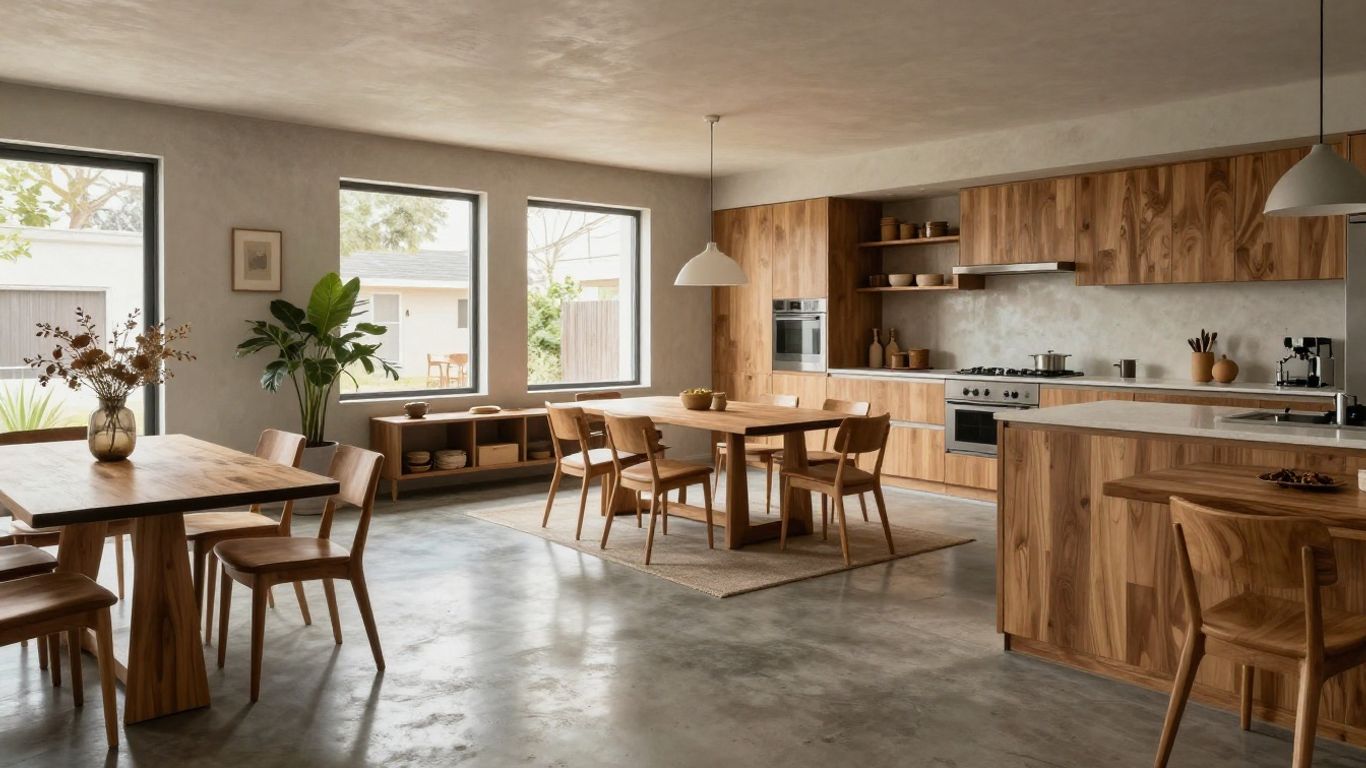
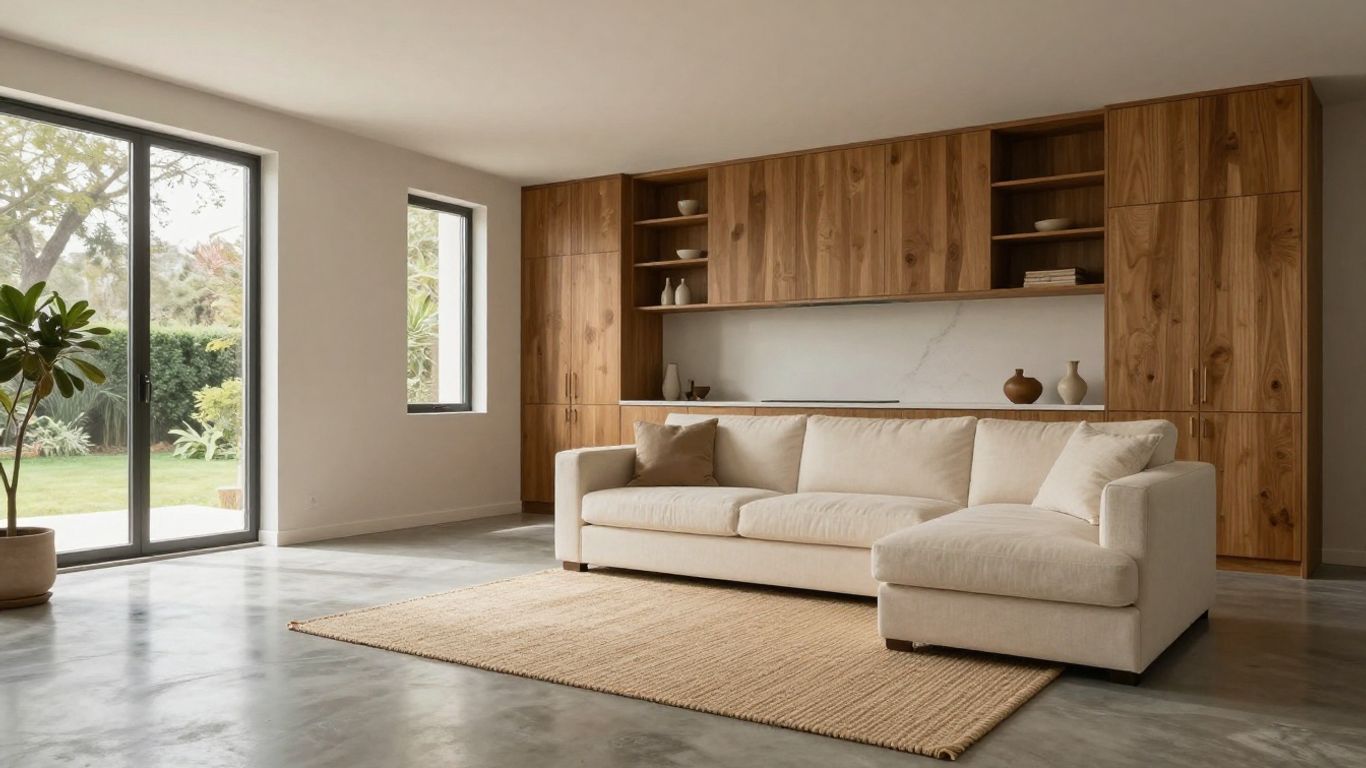
The visual effect also depends on the surrounding materials. Warm timber, rugs, upholstered furniture, and textured fabrics can soften the clean mineral character of concrete. For design context, this polished concrete home inspiration illustrates how wood and other natural finishes can make a concrete floor feel less industrial without hiding its character.
New-slab versus existing-floor considerations
A new slab gives the design team more influence over concrete color, aggregate selection, joints, flatness, curing, and protection during construction. Those decisions need to happen before the pour, not after the floor has already been covered. A newly poured slab also needs to reach an appropriate cure state; many specifications allow a minimum concrete age of 28 days before polishing, subject to site evaluation and moisture behavior.
An existing floor offers a different kind of opportunity. Its age is not automatically a problem, but old adhesive, paint, repairs, cracks, contamination, and uneven placement can all affect the finished appearance. A test grind on the actual slab is much more useful than relying on a photograph or a generic sample because it reveals what the chosen depth will expose.
Weighing the benefits and drawbacks
Polished concrete can be a practical choice, but it is not universally comfortable or visually uniform. Its strengths come from using a hard, continuous structural surface with relatively few joints and no sacrificial top layer. Its drawbacks come from the same qualities: concrete is hard, changes with light, and faithfully reveals aspects of the original pour. The right decision balances appearance with how the household actually lives.
Durability and long-term performance
A well-prepared polished slab can handle substantial household traffic, rolling loads, and everyday wear without the peeling associated with a topical coating. Its long-term performance still depends on the concrete itself, the quality of preparation, the selected protection, and how spills and grit are managed. Polishing does not make a structurally weak or badly contaminated slab sound.
Small chips, scratches, and areas of dullness can often be assessed and treated locally, though repairs may remain visible because the surrounding concrete has its own aggregate and color variation. The goal is usually a floor that ages honestly and remains serviceable, not one that stays perfectly identical in every patch of light.
Cleaning, maintenance, and indoor air quality
Routine care is usually straightforward: remove loose grit, clean with a neutral product recommended for polished concrete, and avoid leaving staining liquids on the surface. Strongly acidic or strongly alkaline cleaners can affect the finish or protection, so aggressive household chemicals are a poor default. Because the floor is not carpet, it does not trap fibers and dust in the same way, although normal household dust still needs regular removal.
A simple maintenance plan is easier to follow when responsibilities are clear. It should cover entry mats, spill response, cleaning frequency, and the product used for damp mopping. The cleaning and recoating guidance is useful for understanding why mechanically polished floors are generally maintained through cleaning, stain-guard care, burnishing, or re-refinement rather than routine waxing.
Design flexibility and visual appeal
Concrete offers more visual choice than its gray reputation suggests. A floor can have a subtle salt-and-pepper look, greater aggregate exposure, a low satin sheen, or a brighter reflective finish. New slabs may allow integral color decisions, while existing slabs have a fixed base color and usually rely on depth of cut, polish level, and the exposed aggregate to shape the result.
The slab sets the character more than a catalog image does. Variations in cement color, stone distribution, trowel marks, joints, and curing can become visible after polishing. That is not necessarily a weakness, but it should be discussed early so expectations match the material.
Common comfort, noise, and surface concerns
Concrete is firm underfoot and can feel cool, especially in poorly insulated rooms or homes without solar warmth. It also reflects sound more readily than carpet or cork, so open rooms may need rugs, curtains, acoustic panels, and upholstered furniture. Dropped objects are more likely to break, and a fall onto a hard floor can be unpleasant for children or older residents.
These concerns do not rule out polished concrete. They simply make room planning important. Soft furnishings, underfloor heating where suitable, and a carefully selected sheen can make the home feel more comfortable without changing the basic floor system.
Choosing the right design and finish
Finish selection should happen before grinding begins, and ideally before a new slab is poured. Four decisions carry particular weight: color, aggregate exposure, depth of cut, and polish level. Texture and slip resistance add a further practical layer, especially around entries and wet areas. Samples from the actual slab are the clearest way to compare these choices.
Gloss levels, aggregate exposure, and surface texture
A matte or satin floor reflects less light and tends to be forgiving of everyday marks. Higher gloss levels create more reflection and can make aggregate appear clearer, but they may also make dust, footprints, and surface variation more noticeable. Depth of cut determines whether the floor retains a fine salt-and-pepper appearance or reveals larger stones in a terrazzo-like pattern.
Texture is a separate consideration from visual roughness. Interior living areas often call for a smooth, refined surface, while ramps, pool surrounds, and exposed wet entries may need built-in grip. The range of polish levels and concrete textures shows why the desired appearance and the required traction should be discussed together rather than treated as one decision.
Colors, stains, dyes, and decorative effects
For a new slab, color can be batched into the concrete mix, making it integral to the slab rather than a late topical treatment. That choice has to be made before the pour and viewed with the intended aggregate and sealer. Existing concrete has a fixed base color; stains and dyes may be possible in some systems, but they do not erase the underlying variation or guarantee a uniform result.
Decorative effects may also come from the aggregate itself. Local stone, seeded aggregate, joints, and carefully planned transitions can give a floor a distinct regional or architectural feel. Always inspect a physical sample because lighting, aggregate distribution, and sealing can shift the apparent color.
Borders, scoring patterns, and custom details
Saw-cut joints, borders, bands, and geometric scoring can organize a large room or echo the lines of cabinetry and walls. They are most successful when coordinated with the slab layout before construction. On an existing floor, joints and hidden services may limit what can safely be cut, while old repairs may interrupt a planned pattern.
Custom details should serve the room rather than compete with it. A restrained border can define a dining zone, but excessive scoring may draw attention to a floor that would otherwise read as calm and continuous. The installer should confirm joint locations, edge conditions, and transitions with the designer or builder before work starts.
Slip resistance and finish selection by room
A polished interior floor can be appropriate in living rooms, kitchens, halls, and bedrooms when spills are managed and the selected finish provides suitable traction. Wet rooms, exterior thresholds, and poolside areas need a more specific assessment of water, barefoot use, gradients, and cleaning. Gloss alone does not determine whether a floor is safe, and a rough-looking surface is not automatically comfortable or effective when wet.
For areas where grip is the primary concern, TextureSafe describes a bush-hammered concrete texture designed for durable slip resistance on surfaces such as pool surrounds, ramps, and entryways. That is a different finish objective from a smooth polished interior and should be specified accordingly.
Estimating the cost of polished concrete floors
There is no reliable single price for every residential project. A simple new slab with clear access and limited edges may be comparatively straightforward, while an existing floor beneath adhesive in a tightly furnished home can require extensive preparation. The quote should explain what is included, what assumptions have been made, and which discoveries could change the scope. A site assessment and test area are often more useful than a broad square-meter estimate.
Main factors that affect installation pricing
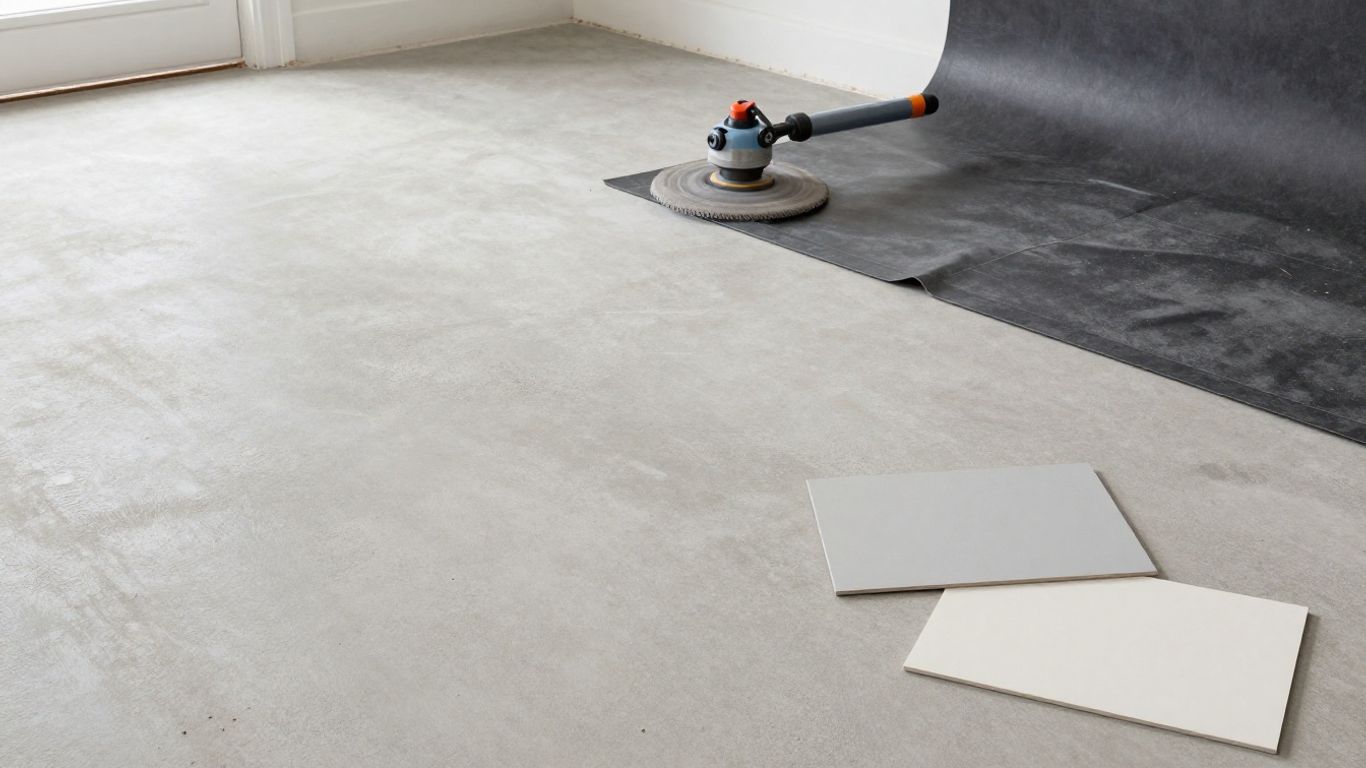
Pricing usually reflects both the floor area and the work required to turn that particular slab into a finished surface. Important variables include concrete hardness, slab flatness, contamination, access, edge length, joint filling, desired exposure, sheen, and the amount of hand work required around walls or fixtures.
A quote comparison is clearer when these elements are separated:
| Cost factor | Why it matters | Typical question to ask |
|---|---|---|
| Slab condition | Repairs and uneven areas add preparation time | What defects were allowed for? |
| Depth of cut | Deeper grinding takes more labor and may reveal more variation | What exposure is included? |
| Edges and access | Perimeters and restricted areas need slower equipment or hand work | Are edge charges included? |
| Finish level | Higher sheen requires additional abrasive stages | What polish level is specified? |
| Protection and cleanup | Occupied homes need containment and careful handover | How will dust and adjoining rooms be managed? |
The point is not to find the shortest quote, but to compare equivalent scopes. This polished concrete cost guide explains why slab condition, adhesive removal, depth of cut, access, and edge work can change the final figure substantially.
Comparing new construction with concrete-floor renovations
New construction can reduce some costs because the slab is open, cabinets are not installed, and floor levels can be coordinated from the start. It also allows decisions about color, aggregate, joints, flatness, curing, and site protection before other trades begin. Those advantages do not guarantee a perfect result, but they reduce avoidable surprises.
Renovation work may involve lifting floor coverings, scraping adhesive, removing old sealers, protecting walls, moving furniture, and correcting areas damaged by previous use. Existing-floor projects can still be excellent candidates, particularly when the slab is sound, but the allowance for discovery should be realistic.
Repair, preparation, and moisture-control costs
Preparation may include adhesive removal, patching, crack assessment, leveling high points, cleaning contamination, and grinding around fixed elements. Moisture behavior also matters. A slab can look dry while moisture movement affects sealers, finishes, or the suitability of the proposed system, so testing and site conditions should be discussed before the work is booked.
Some cracks are mainly cosmetic; others indicate movement that needs a broader building assessment. Similarly, an oil stain may be manageable in one area and deeply embedded in another. A responsible quote distinguishes known preparation from allowances for what only becomes visible after coverings are removed.
Long-term value and replacement considerations
Polished concrete can offer long service life because the finished surface is the concrete slab rather than a separate wear layer. That may reduce the cycle of replacing carpet, vinyl, or other floor coverings, but it does not make polishing the cheapest choice in every home. Initial preparation can be significant, and repair work may be visible rather than invisible.
Value also includes cleaning effort, resilience, design longevity, and the cost of adapting adjacent rooms. The comparison of polished concrete with other flooring types is helpful when weighing upfront expenditure against maintenance, room suitability, acoustic performance, and expected lifespan.
Deciding whether polished concrete suits your home
The best candidate is not defined by architectural style alone. A polished floor can work in a contemporary open-plan house, a renovated bungalow, a garage conversion, or a practical family home when the slab and daily use support it. The decision should consider comfort, moisture, insulation, acoustic behavior, and the feasibility of accessing the concrete. A floor that looks appealing in a photograph may still be wrong for a particular household.
Room-by-room suitability
Living rooms and open-plan kitchens are often strong candidates because a continuous floor can connect several zones. Hallways and home offices can also benefit from easy sweeping and a consistent finish. Bedrooms are more personal: some residents enjoy the clean surface, while others prefer the warmth and softness of textiles.
Bathrooms, laundries, and entries need a detailed review of water, falls, thresholds, and traction. Garages and workshops may suit a ground or polished finish, but their contamination, loading, and maintenance needs differ from those of an interior living space.
Climate, insulation, and radiant-heating considerations
Concrete responds to the thermal conditions around it. In a well-insulated home with good solar access, its thermal mass may contribute to a stable indoor environment; in a cold or poorly insulated building, the floor may feel uncomfortably cool. Rugs and furnishings can help, but they do not replace proper building-envelope decisions.
Radiant heating can be compatible with concrete floors when it is designed into the slab and coordinated with structural, insulation, curing, and finish requirements. Retrofitting heating beneath an existing slab is a different and more disruptive proposition. Confirm the heating design with the relevant building professionals before assuming polishing will solve thermal comfort.
Moisture, cracking, and subfloor limitations
Mechanically polished concrete requires a suitable structural concrete slab. A framed timber floor without a qualifying slab is not simply converted by applying a polishing process. Existing slabs under carpet, tile, paint, or adhesive may be candidates, but the coverings need to be removed before the actual condition can be judged.
Cracks, joints, unevenness, and previous repairs remain part of the feasibility assessment. The existing-slab assessment guide explains why age alone does not decide the outcome and why a test grind can reveal more than a visual inspection from above the old floor covering.
When another flooring material may be a better choice
Another floor may be more appropriate if the home needs a notably soft surface, highly absorbent acoustics, easy concealment of future repairs, or a lightweight system over a nonconforming subfloor. Polished concrete may also be a poor fit where access is severely restricted or where the existing slab has movement and moisture problems that cannot be responsibly managed.
That is not a failure of polished concrete. It is a reminder that flooring is part of the building system. Choose the finish that matches the slab, the room, and the people using it rather than forcing a visual preference onto unsuitable conditions.
Planning the installation process
Good results begin before the grinders arrive. The installer, builder, designer, and homeowner should agree on the intended exposure, color expectations, sheen, edge treatment, protection requirements, and handover standard. New construction benefits from specialist involvement before the pour, while renovation work needs a clear plan for removing coverings and protecting occupied areas. Clear communication prevents many expensive assumptions.
Inspecting and preparing the concrete slab
The first stage is a practical inspection of the slab and its surroundings. The assessment should consider flatness, cracks, joints, contamination, moisture, access, fixed cabinetry, wall edges, and the likely depth required to reach the desired appearance. A small test area can show aggregate size, color, repairs, and the effect of the proposed cut.
For new work, the site should be protected from rust, oil, paint, plaster, and other contamination while the slab cures. For existing floors, old adhesive, coatings, and loose material need to be removed or evaluated. The pre-pour planning guide covers the value of early involvement, slab flatness, curing, protection, and setting realistic expectations about natural variation.
Grinding, patching, polishing, and densifying
Initial grinding removes surface irregularities and establishes the required depth. Patching may follow, though patched areas can remain visible because they do not contain the same aggregate as the original slab. Densification hardens the prepared concrete, and progressively finer abrasives then hone and polish the surface to the agreed level.
The final stages may include a penetrating stain guard or sealer, depending on the environment and specification. Each step affects the next, so changing from a subtle exposure to a deeper cut late in the project can alter labor, appearance, and timing. Approve a sample before the full floor is completed whenever the slab’s character is uncertain.
Coordinating walls, cabinets, doors, and baseboards
Floor height and edge access need to be discussed before cabinets, doors, skirtings, and trims are fixed. Existing rooms may have narrow gaps that require hand work, and removing baseboards can reveal old paint lines or damaged plaster. Door clearances may change if preparation or patching raises the finished level.
A clear sequence helps: inspect the slab, establish the finished height, complete dusty preparation before delicate joinery, and protect the floor while later trades finish. The more built-in furniture a room contains, the more important the edge and access allowance becomes.
Setting expectations for dust, noise, and project timing
Grinding is noisy and can generate fine dust even when dust-control equipment is used. Occupied homes may need rooms emptied, doors sealed, ventilation planned, and pets or sensitive occupants relocated during the loudest stages. Access also affects productivity; a large open room is handled differently from a sequence of small furnished spaces.
Timing depends on floor area, preparation, repairs, edge work, moisture conditions, and the chosen finish. Allow time for inspections, sample approval, grinding, polishing, protection, and final cleaning. A realistic program is preferable to a rushed promise, particularly when other trades depend on the finished floor.
Maintaining polished concrete after installation
Maintenance is uncomplicated when it begins with the right products and a sensible routine. The floor should be treated as a refined mineral surface, not as a maintenance-free object. Grit, spills, dragging furniture, harsh chemicals, and neglected protection can all affect its appearance over time. Regular care preserves the finish and makes occasional restoration more manageable.
Recommended cleaning products and routines
Use a soft dust mop, vacuum suitable for hard floors, or other non-abrasive method to remove grit. Damp mop with a neutral cleaner approved for polished concrete, following the product dilution instructions. Remove wine, oil, food, and muddy water promptly rather than allowing them to sit while the household carries on.
Avoid strongly acidic cleaners, harsh alkaline products, abrasive powders, and untested household treatments. If a cleaner leaves a film, changes the sheen, or seems to dull the floor, stop using it and ask the installer or product supplier for a compatible alternative.
Preventing stains, scratches, and surface damage
Entry mats reduce the grit that causes fine abrasion, while felt pads under furniture help prevent scratching during ordinary movement. Lift heavy items instead of dragging them, and use suitable protection under plant pots, metal legs, and wheeled equipment. Standing water should not be treated as harmless simply because the floor is concrete.
Spill response is especially useful in kitchens, dining rooms, garages, and workshops. A polished floor may resist many everyday marks, but resistance is not the same as immunity. The longer a staining substance remains in contact with the surface, the more difficult the cleanup may become.
When to reseal or restore the finish
Mechanically polished floors do not normally need a wax layer or routine film-forming recoat. A penetrating stain guard may need attention as its performance declines, while a dull or worn area may be improved by burnishing or mechanical re-refinement. The correct intervention depends on whether the issue is dirt, sealer condition, scratching, contamination, or actual surface wear.
Have the floor assessed before applying a new product. An incompatible sealer can create a larger problem, and adding layers without addressing the cause may change the appearance unevenly. Restoration is often more controlled when planned before damage becomes widespread.
Protecting floors from furniture and everyday wear
Use non-marking pads, keep gritty debris out of high-traffic paths, and place absorbent mats where wet shoes or muddy pets enter. Dining chairs and bar stools deserve particular attention because repeated small movements can create concentrated wear. Felt pads should be checked and replaced when they collect grit.
Everyday wear is not necessarily a reason for alarm. A floor may develop subtle changes in sheen and color as it is used, especially in paths exposed to sunlight and traffic. Good maintenance slows that change, while periodic professional care can restore clarity without pretending the material has never been lived on.
Conclusion
Residential polished concrete floors can provide a durable, continuous, and distinctive finish, but the result begins with the slab rather than the final polish. Evaluate the concrete, agree on exposure and sheen, budget honestly for preparation, and plan comfort, moisture, access, and maintenance alongside appearance. When those decisions are made early, polished concrete becomes a considered part of the home rather than a last-minute treatment applied to an unknown surface.
Frequently Asked Questions
Can an existing concrete slab be polished?
Often, yes, if the slab is structurally suitable and its condition, contamination, moisture, cracks, and required preparation are acceptable. Removing old coverings and carrying out a test grind are usually necessary before confirming the likely result.
How long should new concrete cure before polishing?
Many projects use a minimum 28-day concrete age as a planning point, but readiness depends on cure state, surface condition, moisture behavior, and the project specification. The installer should assess the actual slab rather than relying on a universal calendar alone.
Is polished concrete suitable for kitchens?
It can be suitable because it is continuous and straightforward to clean, but spills should be removed promptly and the selected finish should suit the room’s lighting and traffic. Rugs and soft furnishings may also improve comfort and acoustics.
Does polished concrete feel cold?
It can feel cool in homes with poor insulation, limited solar warmth, or low indoor temperatures. Building-envelope design, rugs, furnishings, and appropriately designed radiant heating can influence comfort.
Is polished concrete slippery when wet?
A smooth polished floor may need careful assessment in wet areas, entrances, and exterior spaces. Slip resistance depends on the finish, water conditions, slope, footwear, and use, so wet zones should be specified separately from dry interior areas.
Does polished concrete need waxing?
Mechanically polished concrete does not normally require wax. Cleaning, appropriate stain-guard care, and occasional burnishing or mechanical refinement are generally more relevant than adding a sacrificial wax film.
How much does residential polished concrete cost?
Cost varies with slab condition, preparation, access, edge work, depth of cut, aggregate exposure, repair requirements, protection, and polish level. A site assessment and test area provide a more useful estimate than a simple area-based figure alone.